

INTELLIGENCE VAULT — TECHNICAL BRIEF
Joint-Operating Blueprint:
Bifurcated Execution Model
A forensic breakdown of the structural mechanics that separate operational entropy from strategic innovation—quantifying the capacity recovery yield for Senior IT Enterprise Leaders.
ALLARI // JOINT-OPERATING BLUEPRINT
BIFURCATED EXECUTION MODEL:
CAPACITY RECOVERY PROTOCOL
CONFIDENTIAL // REV 2026.02
Visualizing the Airlock
The Operational Airlock enforces a structural separation between two domains. Zone A absorbs operational entropy—patching, access requests, alert triage, vendor coordination—preventing it from contaminating Zone B, where your architects execute strategic initiatives. The barrier between them is not organizational; it is architectural.
[DIAGRAM: BIFURCATED_FLOW_MAP_V1.2]
ID² Governance
Firewall
100% of requests stripped
of noise & codified
before assignment
AIRLOCK GATE
Operational Run
ALLARI CUSTODY
Routine maintenance, ticket toil, and ERP entropy neutralized by Allari specialists
Strategic Build
CORE TEAM
Senior bandwidth strictly reserved for high-value roadmap execution
Allari Engine
HOVER FOR TELEMETRY
Client Core Leaders
HOVER FOR TELEMETRY
ID² Governance Firewall
100% of requests stripped of noise & codified before assignment
AIRLOCK GATE
Operational Run
ALLARI
Strategic Build
CORE TEAM
Allari Engine
Client Leaders
ALLARI CUSTODY
- Patching & maintenance orchestration
- Access request triage & provisioning
- Alert monitoring & incident response
- Vendor coordination & escalation
- Legacy application custody
- CNC builds & environment management
YOUR TEAM
- Cloud migration & architecture
- AI/ML strategy & roadmap execution
- Digital transformation initiatives
- New product development
- Process re-engineering
- Innovation & competitive advantage
> ARCHITECTURE_PRINCIPLE: Operational entropy is ring-fenced. Strategic work is never contaminated by unplanned interruptions. The barrier is structural, not procedural.
Forensic Flow: A Ticket Through the Allari Engine
Every work item entering the Allari Engine passes through three governed stages. No ticket reaches execution without classification, codification, and verified routing. This is the mechanism that converts chaos into predictable flow.
[DIAGRAM: ID²_GOVERNANCE_FLOW_V3]
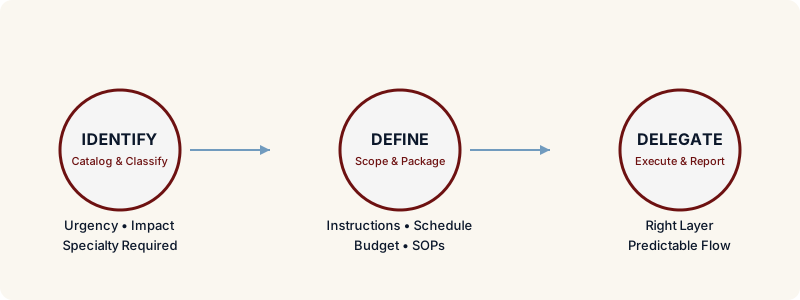
IDENTIFY
Intake Classification
Every inbound signal—ticket, alert, email, Slack message—is normalized and classified within 60 seconds. Urgency, impact, and specialty requirements are scored. Operational noise is separated from strategic signal.
DEFINE
Scope & Codification
The classified ticket is scoped with explicit instructions, dependencies, schedule constraints, and budget allocation. SOPs are created or referenced from the Dynamic Runbook™. Nothing proceeds without a codified definition.
DELEGATE
Execution & Reporting
Work is routed to the correct execution layer—embedded specialist, automated script, or Power of 15™ sprint allocation. Execution outcomes are logged, knowledge is captured as permanent IP, and OpenBook™ provides continuous visibility.
Capacity Recovery Projections
The following projections model capacity recovery for a Senior IT Enterprise Leader role after Allari assumes custody of Zone A operations. Data derived from validated engagements across ERP environments (JDE, SAP, Oracle Fusion).
[TABLE: CAPACITY_RECOVERY_SENIOR_ARCHITECT]
| Metric | Month 3 | Month 6 | Month 12 |
|---|---|---|---|
| Hours Reclaimed / Week | 8–12 | 16–22 | 24–30 |
| Cumulative FTE Equivalent | 0.20–0.30 | 0.40–0.55 | 0.60–0.75 |
| Roadmap Velocity Improvement | +15% | +28% | +40% |
| Context-Switch Incidents / Day | ↓ 55% | ↓ 72% | ↓ 88% |
| Unplanned Work Ratio | 38%→22% | 22%→14% | 14%→8% |
> BASIS: VALIDATED_ENGAGEMENT_DATA // SAMPLE: 4 ENTERPRISE ENVIRONMENTS // ROLE: SENIOR_ARCHITECT
[GATE: PRIMARY_INTERDICTION]
STOP GUESSING.
QUANTIFY YOUR DRAG.
The capacity trapped inside your operations is measurable. A forensic audit quantifies exactly how many architect-hours are consumed by entropy—and what you recover when it is removed.
> VERIFIED_BY: SENIOR IT ENTERPRISE LEADER // METHODOLOGY: BIFURCATED_EXECUTION_V2.1