
Why Frameworks Fail—and Why This One Doesn't
Most IT execution failures are structural, not talent-based. Aging tickets, unplanned work, and capacity loss are symptoms of broken systems—not missing skills.
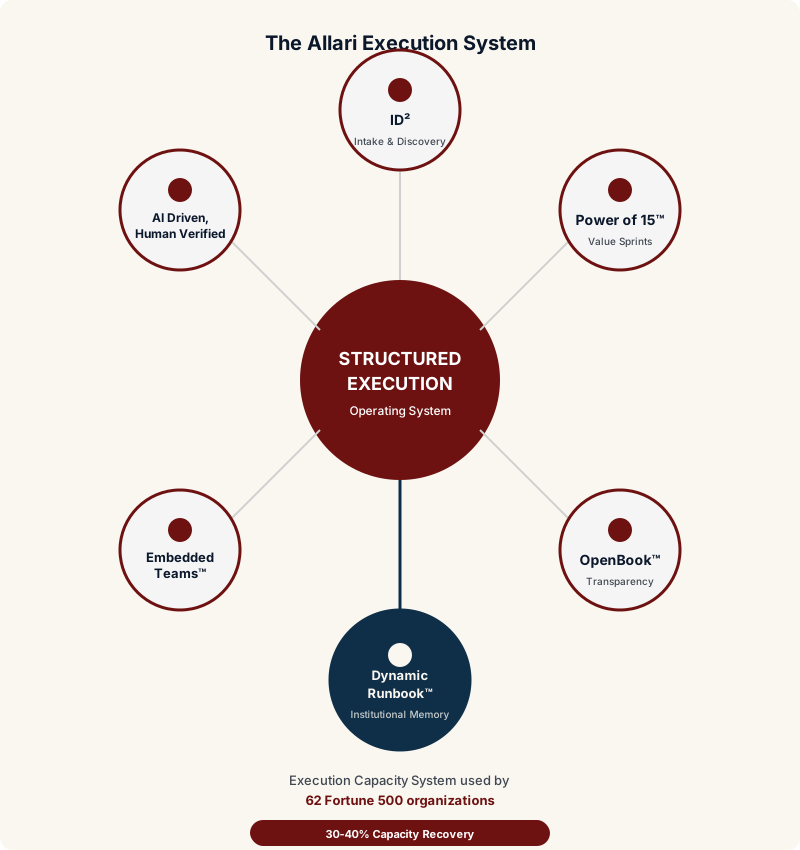
Traditional frameworks describe what should happen. Allari's Framework is the operating system that makes it happen—the proven model behind the Executive Diagnostic, 90-Day Stability Plans, and the Embedded Teams that keep roadmaps moving quarter after quarter.
What symptoms does Structured Execution resolve?The Shield for Your Core Team
Your Core Team holds the tribal knowledge that drives your competitive advantage. They are the only ones who truly understand the intersection of your business logic and your ERP.
When you force these high-value leads to manage routine maintenance, password resets, and "Keeping the Lights On" (KTLO), you aren't just losing time—you are burning out your most critical assets. This is Resource Kidnapping.
How the Engine Protects the Core
<15min
Human Response
15-Minute Response Triage
We don't just "hit a timer." Allari delivers an immediate human response to operational noise, ensuring that a P3 ticket never escalates into a distraction for your Core Team.
100%
Run Absorption
Total Operational Custody
We assume the burden of the daily Run—including CNC, functional support, and environment patching—so your Core Team Leads can focus 100% on Strategic Roadmap Execution.
30-40%
Capacity Recovered
Neutralizing Execution Drag
By absorbing the repetitive noise of the system, we recover 30-40% of your Core Team's capacity—expanding roadmap velocity without increasing headcount.
Core Team Benefit Map
How the Five Components Work Together
ID² controls intake—classifying work and routing it correctly so specialists aren't drowning in low-value tasks.
Power of 15™ measures delivery in 15-minute units, exposing capacity leaks and accelerating throughput.
OpenBook™ provides continuous visibility into execution, capacity consumption, and value delivery.
AI Driven, Human Verified accelerates pattern detection while maintaining 99.7% deployment accuracy.
Embedded Teams™ apply the full framework to stabilize operations and deliver strategic initiatives.
The Five Components
Uncontrolled Intake
No prioritization or demand control
Reactive Operations
Firefighting replaces structure
Recurring Failures
Drift & outages repeat
Leadership Pressure
Trust erodes, pressure rises
Structured Execution Layer
Intake & Dispatch Transformation
Monitoring & SLA Management
Root Cause Analysis & Config Monitoring
Predictable Operations Restored
Change Success
Backlog Reduction
More Capacity
Min First Response
ID² — Identify, Define & Delegate
Intake Governor
AI identifies recurring patterns and work misclassification. Human experts validate root causes and set prioritization rules that restore demand control.
Power of 15™ Sprints
Velocity Gearbox
Work measured in 15-minute value units. Creates visibility, velocity, and accountability. Leaders can reject any block that didn't deliver value.
OpenBook™ Transparency
Instrument Panel
Real-time view into every unit of work. No black boxes. AI generates analytics; humans validate accuracy.
Embedded Teams™
Strategic Scaling
Cross-functional teams that apply the full framework to stabilize operations and deliver initiatives—without adding permanent headcount.
AI Driven, Human Verified
Safety Protocol
AI delivers speed; humans ensure correctness. Analyze patterns at scale, deploy only verified automation. 99.7% accuracy guaranteed.
The Allari Execution System
Capability Dependencies
Each layer builds on the previous, from foundational work classification to strategic scaling
ID² — Identify, Define & Delegate
Foundation Layer
Work classification and intake control
Power of 15™
Capacity Management
Value sprints and execution rhythm
OpenBook™ Transparency
Operational Visibility
Real-time status and metrics
Embedded Teams™
Strategic Scaling
Cross-functional delivery
SLAs with Financial Teeth
Financially-backed response times. When we miss, you don't pay. No "best effort" clauses.
System down, business halted
Degraded performance, workaround exists
Limited impact, workaround available
Cosmetic or minor inconvenience
Service Credit Structure
Credits applied when SLA achievement falls below threshold
When to Apply: Decision Matrix
Match operational symptoms to systematic interventions
| Trigger Condition | ID2 | Power of 15 | OpenBook | Embedded Teams |
|---|---|---|---|---|
| High ticket backlog | ● | ○ | ○ | ○ |
| Capacity constraints | ○ | ● | ○ | ○ |
| Visibility gaps | ○ | ○ | ● | ○ |
| Skill shortages | ○ | ○ | ○ | ● |
Application Note:
Organizations typically implement capabilities sequentially based on primary operational constraints. When two or more trigger conditions persist beyond one quarter, systematic intervention demonstrates 3-4x ROI within 6 months across 50+ enterprise implementations.
SERVICE LEVEL CONFIGURATOR
Choose Your Entry Point
Every engagement follows the Relief → Stability → Growth progression. Start where your organization needs it most.
Relief
- Incident Resolution
- Change Freeze Protocol
- Emergency Triage
- Ticket Backlog Clearance
- 24/7 Escalation Support
Immediate triage and stabilization of critical systems. Stops cascading incidents and clears emergency backlog.
Stability
- Root Cause Analysis
- Fragile Artifact Removal
- Patch Currency
- Change Success Optimization
- Knowledge Documentation
- Process Standardization
Root cause elimination and fragile artifact removal. Transforms reactive operations into predictable execution.
Growth
- Embedded Outcome Teams
- Architecture Modernization
- CI/CD Pipeline Support
- Platform Upgrades
- Integration Development
- Capacity Expansion
Strategic capacity unlocked for modernization, new projects, and competitive initiatives. Your team leads; we execute.
Not sure which phase? Our Executive Diagnostic will map your current state.
SYSTEM_MODULE: TCO_COMPRESSION_ENGINE
Turning Operational Gaps into Automated Utilities
We don't just fill your resource gaps; we optimize them. Allari's primary objective is to identify your high-friction functions and re-engineer them to be as automated and cost-effective as possible. By stripping away the vendor markup and applying the Execution Engine, we drive the True Cost of Ownership to its absolute floor — all while delivering output at standard FTE run-rates.
TCO Optimization through IT Automation Engineering. Allari's Compression Cycle delivers Operational Cost Compression by converting manual, high-friction IT functions into automated utilities at FTE Parity. Verified: 19% Year 1 cost compression at Site HT-2025.
THE ALLARI COMPRESSION CYCLE
Identify the Resource-Heavy Gap
We isolate the functions consuming disproportionate budget and bandwidth — network security alerts, DB patching, identity provisioning, VM management — and quantify their True Cost of Ownership.
STATUS: INTAKE
Strip to Core Requirements
Every function is forensically audited to separate essential operations from vendor-inflated complexity. We identify the hidden factories, manual workarounds, and billable overhead that inflate TCO.
STATUS: AUDIT
Apply the Allari Engine
ID² governs intake. Power of 15™ compresses execution. Human-Verified AI™ automates the mundane. Dynamic Runbook™ codifies the volatile. The function transforms from manual liability to automated utility.
STATUS: HARDENING
Operate at Minimum TCO
The function now runs at its lowest possible cost of ownership, delivered at FTE-parity rates. No consultant markup. No manufactured complexity. Just stabilized, predictable operations.
STATUS: STABILIZED
TCO OPTIMIZATION LOGIC: TRADITIONAL SPECIALIST VS. THE ALLARI ENGINE
"Keep it complex to justify the premium."
"Stabilize, Automate, and Compress."
High billable hours at Consultant rates.
Minimum TCO at FTE run-rates.
Manual intervention / Ticket-based.
Predictive Automation / Zero-Friction.
Long-term dependency on the vendor.
Long-term departmental Hardening.
The compression cycle is not theoretical. At Site HT-2025, Allari drove 19% operational cost compression in Year 1 while simultaneously reducing resolution velocity from 16 days to 1.77 days — proof that automation and custody reduce cost and accelerate output simultaneously.
Aligned Cost Model
Unlike fixed retainers that charge for capacity you don't use, we align costs with actual execution.
CAPPED-CONSUMPTION MODEL
Budget Safety + Pay Actuals
Set a Cap to sleep at night. Pay Actuals to save money.
HellermannTyton: 81% of Cap → 19% Savings Returned to Client
Start with the Executive Diagnostic
We measure maturity across each component, identify breakdowns, and quantify capacity loss. The result is your 90-Day Stability Plan—prioritized interventions designed to restore execution capacity fast.
Result: 30–40% capacity recovered, sometimes as quickly as 12 weeks.