
What Happens When Oracle Ends JDE Support?
Oracle's Lifetime Support Policy has a defined architecture: Premier Support, Extended Support, Sustaining Support. Here is the full picture — what's confirmed, what's contingent, and what the operational consequences are at each stage.
The Timeline: What Oracle Has Announced
As of March 2026, Oracle has extended Premier Support for JD Edwards EnterpriseOne 9.2 through at least December 2037. That extension is the latest in a pattern of annual revisions: the Premier Support date has moved from 2025 to 2028, then 2030, 2031, 2032, 2033, 2034, 2035, 2036, and now 2037. Oracle's commitment is to review the date annually and may extend it further.
The word "at least" is the operative phrase. It signals a floor, not a ceiling. Oracle has explicitly stated it evaluates support dates annually and may extend them — it has done so every year for the past decade.
JDE E1 9.2 Premier Support — extended through at least December 2037
The other JDE product line tells a different story. JD Edwards World A9.4 exited Extended Support in April 2025 and is now in Sustaining Support — the lowest tier under Oracle's Lifetime Support Policy. Organizations still running World A9.4 receive access to previously released patches and documentation, but no new bug fixes, no new security patches, and no new regulatory updates.
Oracle's March 2026 workforce reduction — up to 30,000 employees, roughly 18% of its global workforce — introduces a structural variable that the support timeline does not capture. As Oracle reallocates capital toward AI infrastructure, the depth of staffing behind legacy application support becomes a legitimate operational question. The 2037 date is contractually committed. The responsiveness behind it is a function of headcount that is actively shrinking.
What "End of Support" Actually Means Operationally
The three-tier Oracle support model has materially different implications at each level.
Premier Support is the full-service tier. You receive new security patches, bug fixes, tax and regulatory updates, certified interoperability with new technology versions, and access to Oracle's support organization. For EnterpriseOne 9.2, this is the current state.
Extended Support covers a limited window after Premier expires — historically three years — and typically requires an additional fee. Third-party certifications, some security updates, and new feature delivery are reduced or eliminated. The scope narrows.
Sustaining Support is where JDE World A9.4 is today. Under Sustaining Support, you keep access to Oracle's documentation, tools, and previously released patches. That is the extent of it. No new patches are created. No new fixes are issued. If a zero-day vulnerability surfaces in your environment, Oracle is not obligated to produce a remediation.
The Operational Consequences
Security exposure compounds. Each year without new patches is a year of accumulating vulnerability. Unpatched systems do not fail visibly — they degrade quietly, creating exposure that auditors and cyber insurance underwriters increasingly price into premiums and coverage terms.
Compliance risk increases. Tax and regulatory updates stop with Premier Support. For organizations operating across multiple jurisdictions, this creates an ongoing manual reconciliation burden — your team is producing by hand what Oracle's support model previously produced automatically.
Talent scarcity accelerates. The pool of JDE-certified engineers who understand your specific release shrinks as vendors and training programs redirect investment toward supported, actively-developed platforms. This is a compounding effect: as support tiers decline, available expertise narrows, which increases the cost and lead time of finding qualified resources.
The Three Paths
Organizations facing a JDE support transition have three structurally distinct options.
Path 1: Migrate
Move to a modern ERP platform — Oracle Fusion Cloud, SAP S/4HANA, or another system. This eliminates the support dependency entirely. It is also a multi-year, capital-intensive undertaking with a well-documented failure rate. Research from ISG published in February 2026 found that nearly 60% of ERP migration projects run over schedule and over budget. The average SAP S/4HANA migration takes approximately 1.5 years under ideal conditions; in practice, 18-month projects routinely extend to three or four years.
Path 2: Third-Party Support
Replace Oracle's support contract with an independent provider — Rimini Street, Spinnaker Support, and others operate in this market. Third-party support can reduce annual Oracle maintenance costs by approximately 50–60%, and providers will support custom code and integrations that Oracle's standard support does not cover. The tradeoff: you do not receive new security patches created for your version (the provider creates compensating controls instead), and this path does not accelerate your migration timeline.
Path 3: Co-Managed Operations
Retain Oracle support, stabilize your JDE environment operationally, and protect your team's capacity to execute either a deliberate migration or a sustained run strategy. This is the approach we see most consistently produce measurable outcomes — not because it delays the inevitable, but because it addresses the primary reason organizations fail at both migration and support transitions: the capacity tax.
Why Most Organizations Can't Migrate Fast Enough: The Capacity Tax Problem
Across 62 Fortune 500 environments measured over 27 years, we observe a consistent pattern: JDE teams operate at 55–65% effective capacity. The rest is consumed by unplanned, reactive work — production incidents, user requests, access management, context switching, patch testing.
| Work Category | Capacity Consumed |
|---|---|
| Unplanned incidents and escalations | 25–30% |
| User requests and access management | 15–20% |
| Context switching and meetings | 10–15% |
| Patch testing and maintenance | 5–10% |
| Available for planned business changes | 30–40% |
When a migration project launches, it draws from that 30–40% window. But migration projects do not reduce the 60–70% consumed by operations. The environment does not become less demanding because a migration is underway. Incidents still occur. Users still file requests. Patches still require testing.
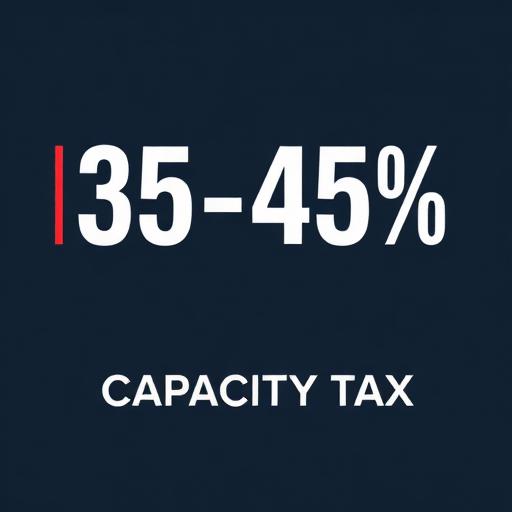
This is what we call the capacity tax. It is not a staffing problem in the conventional sense — adding headcount does not change the ratio. Allari's State of IT Capacity report quantifies this across enterprise environments: 35–45% of enterprise IT budget produces zero strategic output, consistently, regardless of team size. The variable is structural, not numerical.
Organizations that attempt JDE migrations without separating their operational burden from their migration workstream are attempting to execute two full-time programs with a partial-time team. The timeline extensions and cost overruns that follow are not failures of execution — they are the predictable output of an unresolved structural problem.
See the full data in The State of IT Capacity: 2026 Benchmark Report.
The capacity patterns driving these operational risks are documented in our benchmark report.
The State of IT Capacity: 2026 Benchmark Report
35–45% of enterprise IT labor capacity is consumed by unplanned, reactive work. 27 years of forensic data across 62 Fortune 500 environments.