
Why ERP Migrations Fail: The Dual-Execution Trap Nobody Talks About
ISG data confirms the pattern — and what the top 10% do differently.
Why 60% of ERP
Migrations Fail
A February 2026 study by ISG found that nearly 60% of SAP migrations fall behind schedule and budget. The firm studied dozens of enterprise programs and identified the primary causes: underestimated complexity, expanded scope, and internal capacity bottlenecks. Technical challenges ranked lower. ISG Partner Stacey Cadigan summarized the pattern directly: "Delays are mostly caused by weak governance rather than technical challenges."
That finding lands differently than most program postmortems suggest. The standard narrative blames the platform, the systems integrator, or the implementation methodology. The data points somewhere else — at the organization's own internal capacity, and whether it was ever realistic to run a migration on top of a team that was already fully consumed running the legacy system.
It was not. And that is the problem.
See the five-stage framework that prevents ERP migration failure →
The Capacity Math That Breaks Every Migration
The IT Process Institute studied over 850 organizations and found that the typical IT team loses 35–45% of its available human labor to unplanned work — reactive incidents, emergency fixes, undocumented one-offs, and interrupt-driven support that was never on any roadmap. This is not a performance failure. It is the structural tax of running a live enterprise system.
That means the typical migration team starts the program at 55–65% effective capacity before a single migration task is assigned.
Then the migration goes on top of that. Data migration workstreams. Testing cycles. Business process validation. Integration mapping. Change management. Program governance. All of it lands on the same team that is already spending 35–45% of its time keeping the legacy system from degrading under normal operations.
The math does not work. It was never going to work. The program was behind before it started.
This is what we call capacity insolvency: the condition in which an organization's planned commitments exceed its actual available throughput at the moment of commitment — usually because no one measured the gap between what was planned and what was structurally possible. The migration did not run out of budget or technology. It ran out of capacity.
What a $172M Failure Looks Like
In 2019, a global medical device manufacturer completed a multi-year SAP S/4HANA migration with a single systems integrator managing the build. The program was large and complex by any measure — but not unusual by enterprise standards.
What was unusual was what happened at go-live. The system was riddled with critical defects. The remediation cost the organization $172M and required a multi-year recovery effort.
The forensic root cause was not a configuration error or a platform limitation. It was Bifurcation Failure — the core internal team was simultaneously accountable for governing the build and maintaining the legacy system through go-live. By the time the system was live, that team had worked through 51 change orders while continuing to own run-state operations. They had no capacity to govern the build. The systems integrator made decisions in the gap. Quality checkpoints were nominal. The system went live before it was ready because no one with the authority to stop it had the bandwidth to see it clearly.
The $172M was not the cost of bad technology. It was the cost of a governance structure that required humans to be in two places at once — and pretended they could be.
What Success Looks Like
At the same time enterprise migrations were accumulating these failure patterns, a different model was operating in the field. During a five-year global SAP migration at W.L. Gore — 3,000 users across 25+ countries, running on JD Edwards — Allari assumed 100% operational custody of the JDE environment. Full ownership. No shared responsibility. No cross-pollination of run-state and build-state accountabilities.
The build team had zero escalations from run-state operations reach them during the five-year program. Not because nothing broke — enterprise systems break — but because the operational layer was structurally separated from the migration layer. The team governing the SAP build never had to context-switch into JDE incident response. They governed the build. That is all they did.
The difference between this program and the $172M remediation is not technology, vendor selection, or project management methodology. It is structural bifurcation: a deliberate architectural decision to separate the team running the current system from the team building the next one. One team owns run state. A different team owns build state. They do not share capacity.
This sounds obvious in retrospect. It is not common in practice.
The ISG Data Confirms the Pattern
The February 2026 ISG study — published on CIO.com — quantifies exactly how widespread this failure mode is. Nearly 60% of SAP migrations fall behind schedule and budget. But the data beneath that headline number is more instructive.
Less than 1 in 5 companies (18%) implement meaningful new processes when migrating to S/4HANA. Nearly half (49%) make few or no changes — they lift and shift. They spend millions moving to a modern ERP platform and then configure it to replicate their existing processes, including the inefficiencies those processes contain.
This is not an accident. It is the direct result of capacity insolvency. When the internal team is already at 100% managing run state, there is no bandwidth for the discovery, design, and change management work required to actually re-engineer processes. The team takes the path of least resistance: map the old system to the new one, as close to one-for-one as possible, and get to go-live.
The result is a platform migration, not a business transformation. The organization pays transformation-level dollars for migration-level outcomes.
ISG's Cadigan identified the governance failure explicitly: "Many migration programs involve multiple system integrators, SAP service providers, and niche specialists. But there is a lack of clear decision-making rights, acceptance criteria, and responsibilities between the providers." Governance does not fail because the governance framework is inadequate. It fails because the people responsible for governance have no capacity to exercise it. The decision rights exist on paper. The bandwidth to enforce them does not exist in practice.
What the Top 10% Do Differently
The organizations that execute ERP migrations successfully do not ask the same team to do both jobs. That is the core pattern — structural, not motivational.
According to DORA research, only 8.5% of teams achieve elite change failure rates of 0–2%. The top 10% keep unplanned work below 20% — less than half the industry median of 35–45%. That gap is not the result of better people. It is the result of better capacity architecture.
What the top 10% do differently:
They bifurcate. Before the migration starts, they establish a clear structural separation between the team responsible for run-state operations and the team responsible for the build. These teams have different accountabilities, different escalation paths, and — critically — different capacity pools. A critical JDE incident does not consume SAP build capacity.
They measure throughput, not just duration. MTTR tells you how long individual tickets take. Mean Resolution Velocity (MRV) tells you whether the team is actually moving work through the system at a rate sufficient to sustain the program. Declining MRV is the earliest measurable signal of capacity saturation — often visible weeks before ticket aging spikes.
They audit capacity before they commit. The first question in a migration readiness assessment is not which platform or which integrator. It is: what percentage of our team's current capacity is consumed by unplanned and run-state work? If the answer is 35–45%, the migration is already behind before it starts.
They quantify the governance load separately. Program governance — decision rights, change control, acceptance criteria, escalation chains — requires dedicated capacity. It does not happen in the margins.
The HellermannTyton engagement illustrates what this looks like operationally: Allari compressed ticket aging from 16 days to 1.77 days, recovered 38.4% of consumed capacity, and achieved 19% TCO compression. That recovered capacity did not come from working faster. It came from structural elimination of the unplanned work that was consuming it.
The Practical Takeaway
If an ERP migration is on your roadmap for the next 12–18 months, the most important question is not SAP S/4HANA versus Oracle Fusion versus NetSuite. It is not which systems integrator has the best S/4HANA practice. Those are execution questions. The prior question is structural: does your team have the actual available capacity to govern and execute this migration while continuing to run the existing system?
The ISG data says 60% of the time, the answer is effectively no — and the organization proceeds anyway because the capacity deficit is invisible until the program is already behind.
A realistic migration readiness assessment starts with a capacity audit: what percentage of your team's labor is currently consumed by unplanned and run-state work? If that number is 35–45% — the industry median — then your effective available capacity for migration work is 55–65% at best. Your migration plan needs to be built against that number, not against a theoretical full-time equivalent that does not exist.
If it is not, you are not planning a migration. You are planning a remediation.
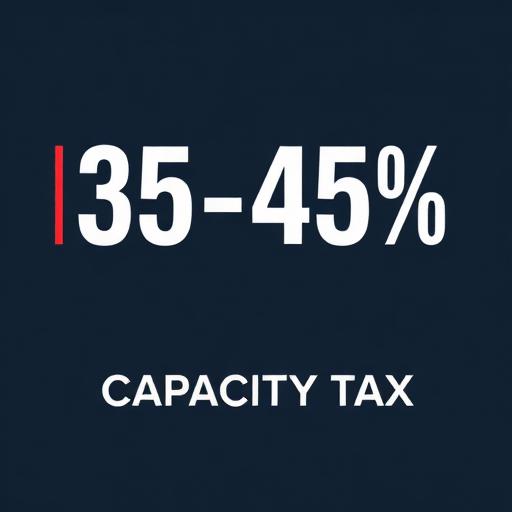
Migration failures are a symptom of the capacity tax. The data is in the report.
The State of IT Capacity: 2026 Benchmark Report
35–45% of enterprise IT labor capacity is consumed by unplanned, reactive work. 27 years of forensic data across 62 Fortune 500 environments.
Related Reading
Greenfield vs Brownfield vs Bluefield
Three structural approaches to ERP migration — and how to choose
JDE Data Migration Complexity
Why F4211 and F0911 break migration timelines
ERP Modernization Strategy
The capacity-first approach to JDE & SAP modernization
Mean Resolution Velocity
The capacity metric most IT teams aren't tracking
Enterprise Migration Field Report
Five-year JDE custody during global SAP migration
What Is Co-Managed IT
The operating model for structural capacity recovery
Frequently Asked Questions
Quantify Your Migration Readiness
Allari's Executive Diagnostic measures your team's actual available capacity — so you know whether your migration plan is realistic before you commit.
Request Executive Diagnostic →A 45-minute structured review of your environment's capacity allocation. Not a sales conversation. We bring the benchmark data. You bring the questions.
Sources
- ISG, "The State of SAP Migrations," February 2026 (via CIO.com)
- IT Process Institute, Visible Ops Study (850+ organizations)
- DORA State of DevOps Report 2025