
How to Reduce JDE Support Costs Without Migrating
JDE organizations looking to reduce support costs typically look in the wrong place. The actual cost driver is structural, invisible to the budget spreadsheet, and consistent across every JDE environment we have measured.
The Real Cost Driver: The Capacity Tax on Your Team
Oracle's JDE EnterpriseOne 9.2 Premier Support runs approximately 22% of the original license fee annually. Third-party support providers can reduce that to 10–12%. That is a real savings. It is also not where most of the money is going.
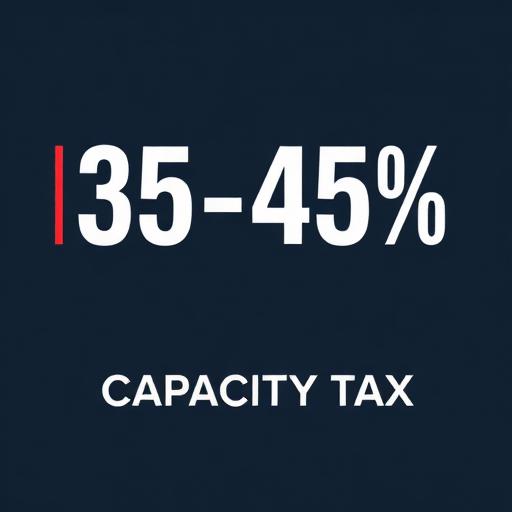
The actual cost driver is what we call the capacity tax: the portion of your team's paid labor that is consumed by unplanned, reactive work that was never budgeted, scoped, or approved. Research across enterprise environments puts this at 35–45% of IT capacity. Our own forensic measurement across 62 Fortune 500 environments — tracked in 15-minute increments, not surveys or self-reported estimates — confirms the number.
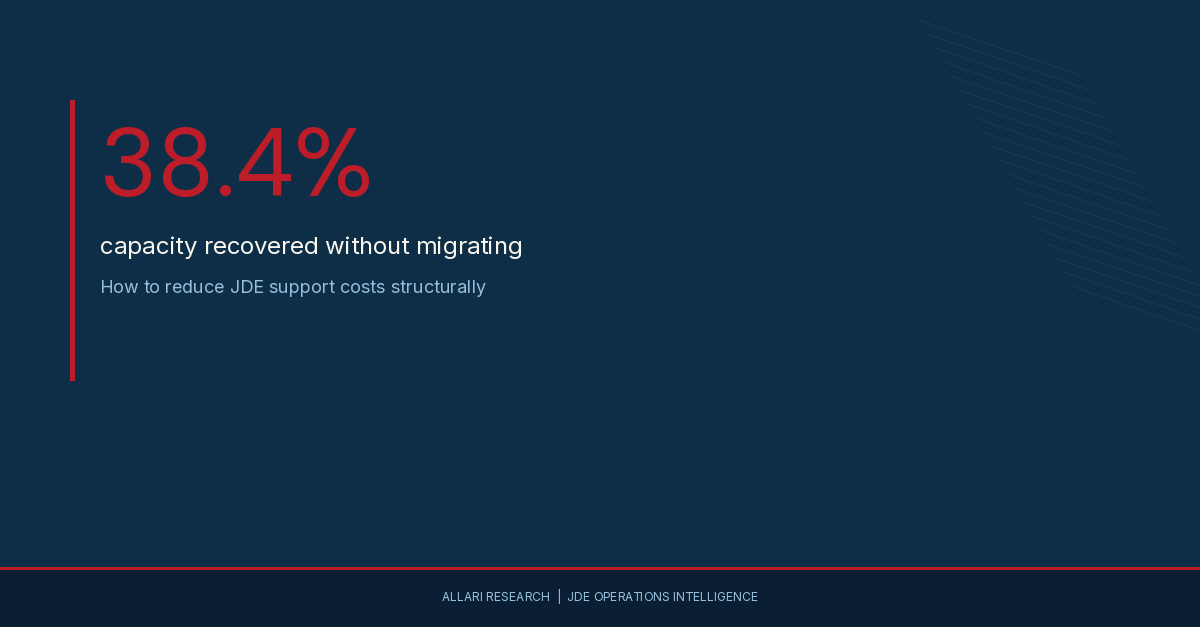
Capacity recovered without migrating — verified median across 62 Fortune 500 environments
| Work Category | Capacity Consumed |
|---|---|
| Unplanned incidents and escalations | 25–30% |
| User requests and access management | 15–20% |
| Context switching and meetings | 10–15% |
| Patch testing and maintenance | 5–10% |
| Available for business changes | 30–40% |
A six-person JDE team with a fully-loaded cost of $150,000 per engineer is spending $135,000–$180,000 per year — per engineer — on work that is not delivering roadmap value. Across the team, the capacity tax at the median represents $500,000–$700,000 in annual labor cost producing no strategic output. That number does not appear anywhere in your Oracle support invoice.
Why Adding Contractors Doesn't Change the Ratio: The Staffing Paradox
The instinctive response to a capacity-constrained JDE team is to add resources. Contract engineers, staff augmentation, additional FTEs. This response is structurally incorrect.
Our State of IT Capacity research documents this explicitly: capacity loss persists regardless of team size, platform, or industry. Adding headcount does not change the ratio — it changes the cost.
The 35–45% consumed by unplanned work is not a function of how many people are on the team. It is a function of how the team's intake process works — or does not work. When an incident occurs, it pulls whoever is available. When a user request arrives, it interrupts whoever is closest to the relevant knowledge. These interruptions are generated by the structure of the operational model, not by the size of the team.
The staffing paradox: every new engineer added to an unstructured JDE environment eventually operates at the same 55–65% effective capacity as the engineers already there. The environment trains the engineer, not the other way around.
Structural Cost Reduction: Three Specific Interventions
Genuine cost reduction in a JDE support model requires structural change, not resource addition. We have identified three interventions that produce measurable, durable results.
Intervention 1: Co-Managed Operations with Operational Bifurcation
The first intervention separates the Run workstream from the Build workstream at the team architecture level. A dedicated operational layer — embedded into your workflow, using your tooling, operating at FTE-parity rates — absorbs the 60–70% reactive workload. Your internal team is restructured to own the strategic workstream exclusively.
This is not outsourcing. The operational layer operates within your ServiceNow, Jira, or equivalent ITSM environment. Every fix is documented in your repository. Every incident resolution builds your institutional knowledge base, not a vendor's. The IP stays with you.
Intervention 2: ID² Intake Classification
The second intervention applies governance to the front of your support queue. ID² — Identify, Define, and Delegate — is Allari's intake classification framework. Every JDE request entering the queue is normalized, scoped, and routed to the correct execution layer before a specialist touches it.
Without intake governance, requests escalate to senior engineers by default — because senior engineers have the institutional knowledge to resolve ambiguity quickly. This is efficient at the individual incident level and catastrophically inefficient at the team level. ID² routes routine requests to the appropriate tier. The result: an 82% reduction in ticket aging, measured across our active portfolio.
Intervention 3: Root Cause Elimination
The third intervention targets repeat incidents. Across JDE environments, a consistent pattern emerges: a small number of failure modes generate a disproportionate volume of incidents. Batch jobs that fail under specific load conditions. Orchestrator workflows that break when upstream system configurations change. Integration endpoints that require manual intervention after each patch cycle.
Root cause elimination applies AI-assisted pattern analysis to incident history, identifies the recurring failure modes, and deploys structured remediation. In our active portfolio, this produces a 60–80% reduction in repeat incidents within the first 90 days.
What 38.4% Capacity Recovery Means in Dollars for a JDE Team
The 38.4% capacity recovery figure is not a projected range or a best-case scenario. It is the verified median across 62 Fortune 500 environments, measured in 15-minute increments over 27 years of operations.
| Team Size | Annual Labor Cost | 38.4% Recovery | Dollar Value |
|---|---|---|---|
| 5 engineers | $600,000 | $230,400 | Strategic reallocation |
| 10 engineers | $1,200,000 | $460,800 | Strategic reallocation |
| 15 engineers | $1,800,000 | $691,200 | Strategic reallocation |
The metric that captures the velocity improvement is Mean Resolution Velocity (MRV). At the HellermannTyton engagement (Site HT-2025, 27-month longitudinal study), MRV moved from 16 days to 1.77 days — an 89% improvement in resolution speed. The same team, resolving the same class of issues, in 11% of the previous time. That is structural change, not headcount change.
The Economics: Pay-for-Use vs. Fixed Headcount
Traditional JDE support models are fixed-headcount models. You hire engineers at market rate, pay them whether strategic work is available or not, and absorb the operational overhead regardless of incident volume. In months with low incident volume, you are paying full cost for partial output. In months with high incident volume, strategic work stops and your roadmap falls behind.
A co-managed operations model has different economics. The operational layer is calibrated to actual incident volume. The 80+ senior competencies available on demand (CNC, SecOps, database administration, Orchestrator architecture) are accessible fractionally, not hired as full-time headcount.
The median payback period for organizations that implement the full bifurcated model is 5.4 weeks. Year-one TCO compression at the HellermannTyton engagement was 19% — returned directly to the client as operating budget.
The first step to measuring your specific number is the Execution Drag Coefficient at /quantify-drag — a two-minute diagnostic that applies verified benchmarks to your team size and cost structure to calculate your current capacity loss and the recoverable dollar value.
The full dataset and methodology are in The State of IT Capacity: 2026 Benchmark Report.
The State of IT Capacity: 2026 Benchmark Report
35–45% of enterprise IT labor capacity is consumed by unplanned, reactive work. 27 years of forensic data across 62 Fortune 500 environments.