
JDE Testing: Why Your Team Dreads Every ESU
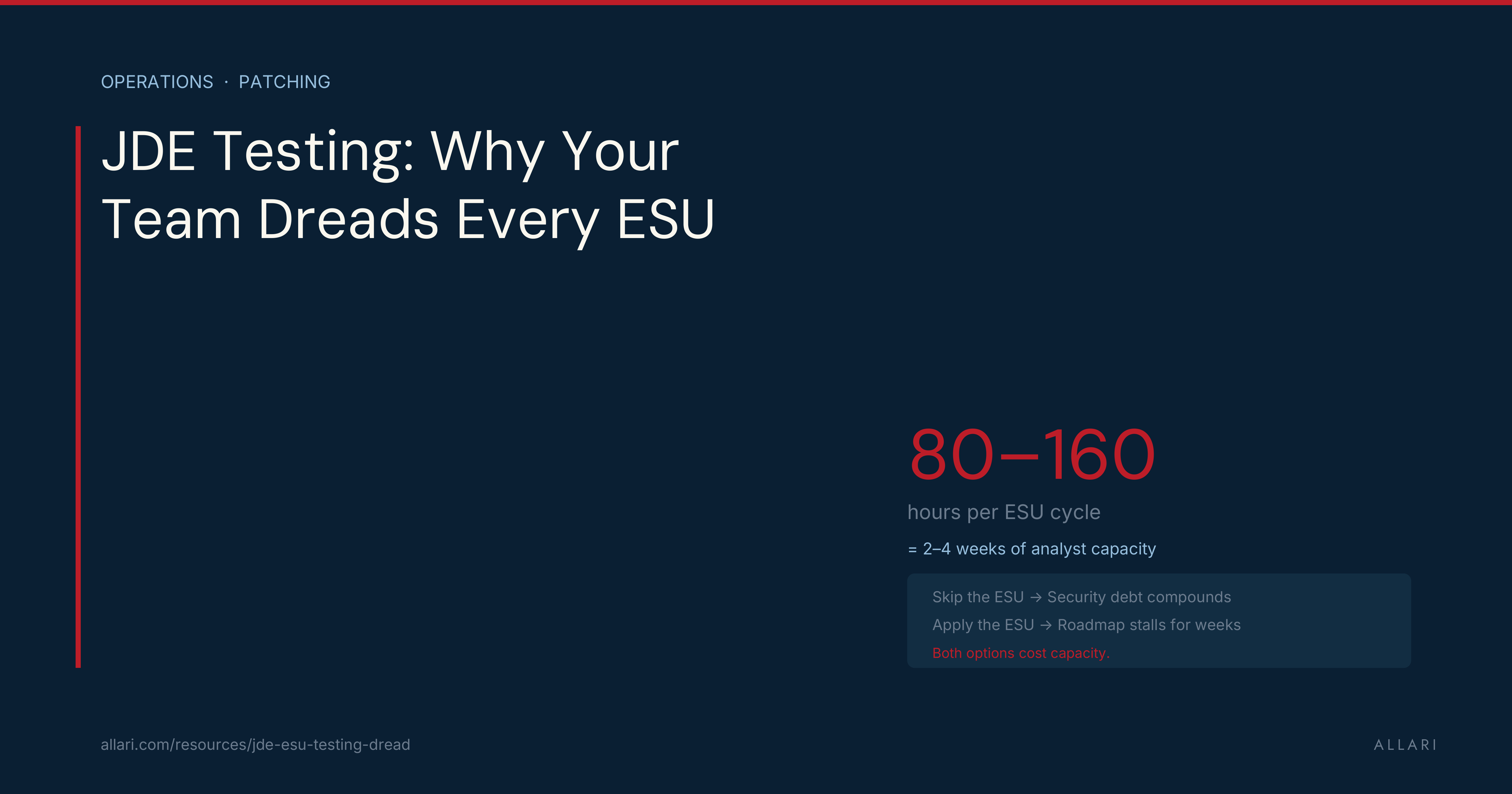
80-160 hours per cycle. And production support doesn't stop.
Every JDE application manager knows the feeling. Oracle releases an ESU. The CNC team reviews the object list. The functional team starts identifying which business processes need regression testing. And everyone's calendar does not clear, because production support does not stop just because testing started.
80-160 hrs
Per ESU Cycle
2-4 wk
Analyst Capacity
3-4x
Cycles Per Year
8-16 wk
Annual Testing Load
The Real Cost of a Single ESU Cycle
In environments with moderate customization, a single ESU cycle consumes 80 to 160 hours of functional testing time. That is 2 to 4 weeks of a senior analyst's calendar.
Multiply across three to four ESU cycles per year: 8 to 16 weeks of functional analyst capacity consumed by patch testing alone. That is one full quarter of a senior analyst's year, applied to validation work rather than anything that improves the environment.
Why Teams Stop Applying ESUs
One postponed ESU becomes two. Then three. Then the environment is 12 to 18 months behind on patches. Security vulnerabilities that Oracle has already addressed are still present. Regulatory and tax updates have not been applied.
When the team finally does apply the deferred patches, the testing burden is not linear. They are validating 12 to 18 months of combined object changes. The testing cycle that was originally 80 hours is now 200. The avoidance behavior created a significantly worse outcome.
Teams skip ESUs to avoid the testing burden — then security debt compounds. The avoidance behavior creates worse outcomes than the testing itself.
The Customization Multiplier
Heavily customized environments face an exponential testing challenge. Custom objects may interact with standard objects in ways that only manifest under specific conditions. Each ESU modifies standard objects, and every customization touching those objects needs retesting.
Automated regression testing tools exist for JDE environments and can reduce the manual testing burden by 40 to 60%. But deploying test automation faces the same capacity constraint as Orchestrator — the team that would build the test suite is already consumed by production support and manual testing.
The Structural Fix
The same structural pattern as every other deferred improvement: the work that would reduce the burden is blocked by the burden itself. The only reliable way out is to reduce the reactive load externally so the team can make the investment.
An Operational Airlock that handles production support while the core team focuses on testing changes the math entirely. Testing gets done completely. Patches stay current. The avoidance cycle breaks.
Find out where your team stands.
Assess your patch currency and testing capacity.
Take the Executive Diagnostic →