
JDE Release 26: The 10 Features Your Team Should Actually Use
30+ enhancements shipped. Most teams deploy 2-3. The problem isn't the features.
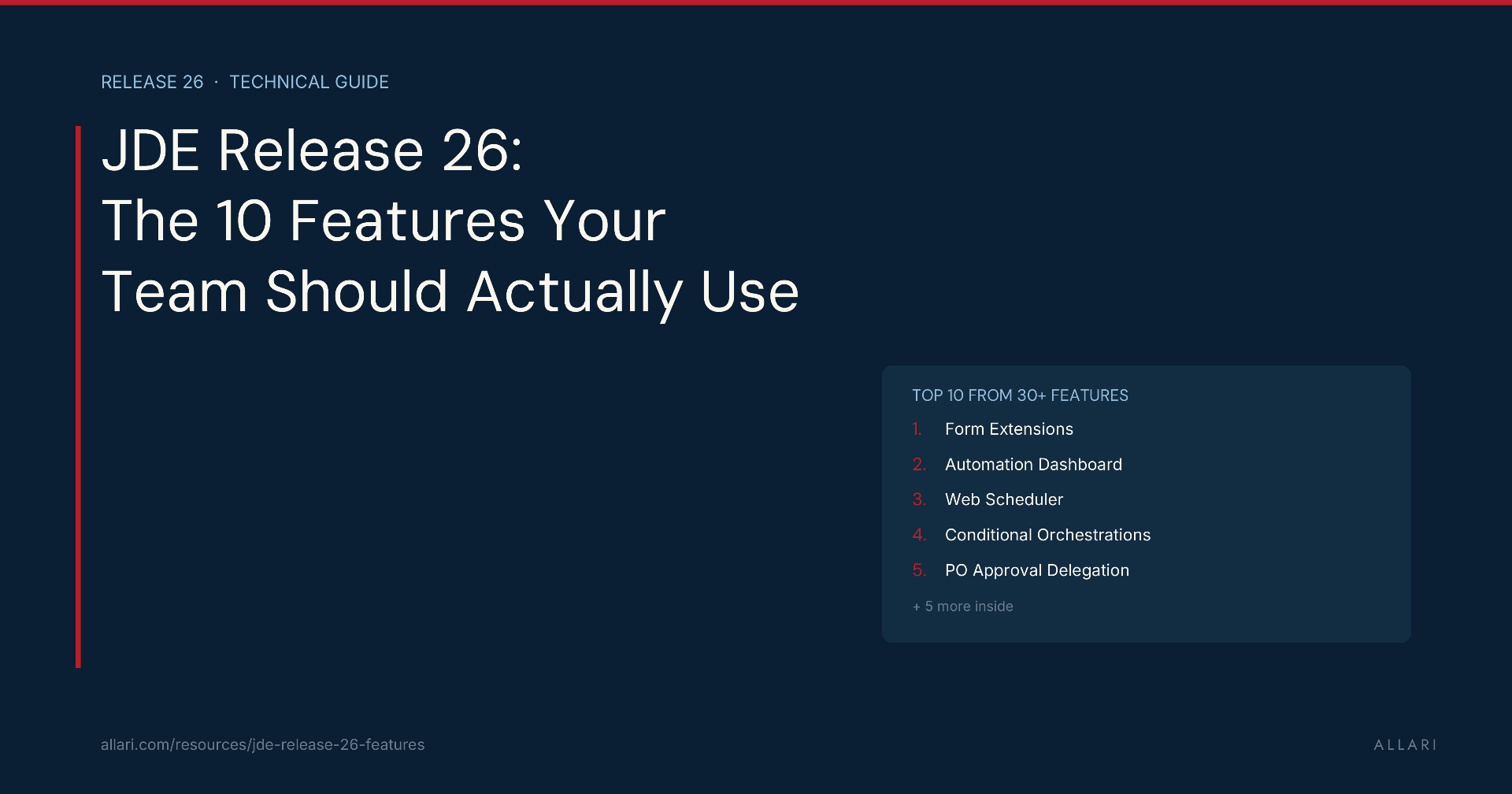
Release 26 shipped in October 2025 with more than 30 enhancements. Every major JDE partner published a feature list. GSI published one. Circular Edge published one. C&A Technology published one. They all covered the full catalogue.
None of them published what it actually takes to adopt the features.
30+
Features Shipped
2-3
Avg Features Adopted
38.4%
Reactive Load Baseline
10
Worth Prioritizing
Across the 62 environments we work with, most teams deploy two or three features from any major release — not because the other features aren't valuable, but because the core team responsible for evaluating, testing, and deploying them is already at capacity before the release notes even land in their inboxes. The list below isn't every enhancement in Release 26. It's the ten worth prioritizing — and an honest account of why most teams won't reach them.
The 10 Features Worth Prioritizing
| # | Feature | What It Does | Why It Matters |
|---|---|---|---|
| 1 | Form Extensions for Power Edit Forms | Customizations to grid-heavy entry screens now handled via web tool | Eliminates Development Client dependency for customizations |
| 2 | Enterprise Automation Dashboard | Consolidated Orchestrator execution visibility | Single interface for monitoring all automation jobs |
| 3 | Web-Based Scheduler | Job schedule management through the browser | Removes Development Client dependency for CNC scheduling |
| 4 | Conditional Launch from Form Extensions | Logic-based Orchestration triggers on field values | More precise automation — fires only when it should |
| 5 | Delegation of PO Approval | Temporary transfer of approval authority | Eliminates approval bottlenecks when approvers are out |
| 6 | Orchestrator Debugging Enhancements | File-based inputs, multi-form request visibility | Faster testing cycles and clearer failure diagnosis |
| 7 | Widgets with User Input | Runtime filter criteria for dashboard widgets | One widget design serves many users — less maintenance |
| 8 | Unified Invoice/Receipt Report | Single report for invoice-to-receipt matching | Cumulative AP close cycle time reduction |
| 9 | Web OMW Table Operations | Object Management Workbench via browser | Reduces friction in change management pipeline |
| 10 | Update Manager Enhancements | Refined ESU/patch application workflow | Less manual steps per patching cycle |
"The value of Release 26 is real. But you can't automate what you can't reach. If your team doesn't have the bandwidth to build the automation, the feature sits unused."
Why Your Team Probably Can't Adopt Them
Each of these features requires three things: evaluation time, testing time, and deployment time. None of those are free.
The median JDE core team we work with spends 38.4% of its available capacity on reactive operations — incident response, escalation management, emergency CNC work, and the constant stream of user-facing support requests that arrive through the ticket queue. That leaves roughly 60% for everything else: roadmap execution, planned upgrades, business-requested enhancements, audit support, and any strategic initiatives that leadership has prioritized.
"Everything else" was already oversubscribed before Release 26 shipped.
When a new release arrives, the evaluation work — reading the documentation, understanding the prerequisites, mapping each feature to your specific environment configuration — takes real time. Testing in a non-production environment takes real time. Documenting the change and training users takes real time. For most teams, this adds up to weeks of effort per feature, not hours.
So the math is straightforward, and it's not flattering: if your team has 60% of its capacity available for non-reactive work, and that 60% is already allocated to existing priorities, Release 26 features go to the backlog. Not because anyone decided they weren't valuable. Because there's nowhere to put them.
The Adoption Pattern We See
What actually gets adopted from a major release is typically whatever a vendor pre-packages in a recommended upgrade, whatever a business unit loudly requests before the testing cycle closes, and whatever happens to be on someone's personal radar who has the informal authority to push it through. That's two or three features, not ten.
The rest of the release — including the Orchestrator enhancements that could genuinely automate hours of manual work per week — sits in a document that everyone intends to revisit and nobody does.
How to Break the Pattern
The Orchestrator capabilities in Release 26 are worth your team's attention specifically because they compound. Every automation you build reduces a class of manual work permanently. The Enterprise Automation Dashboard makes those automations easier to maintain. The Conditional Launch enhancement makes them more precise. These features interact. Teams that adopt them together get more value than teams that adopt them individually.
But you can't build automation with time you don't have.
The upstream problem is the reactive load. When 38.4% of your core team's capacity is consumed by incident response and production firefighting, the capacity for any kind of proactive work — automation development, feature evaluation, upgrade testing — stays structurally limited. Adding headcount doesn't solve it if the new people are absorbed into the reactive queue.
Recovering that capacity is a root-cause problem, not a headcount problem. It requires understanding which incidents are recurring and addressable, which parts of the environment generate disproportionate ticket volume, and where the structural gaps are that keep producing reactive work. When that analysis drives operational changes, teams find bandwidth. When they find bandwidth, they start reaching the feature backlog.
Release 26 has real value. The question is whether your team has the space to capture it.
Find out where your team stands.
See where your environment sits in the JDE lifecycle.
Take the Executive Diagnostic →