
Oracle Extended JDE Support to 2037 — What Changed and What Didn't
The date moved. The structural problems didn't.
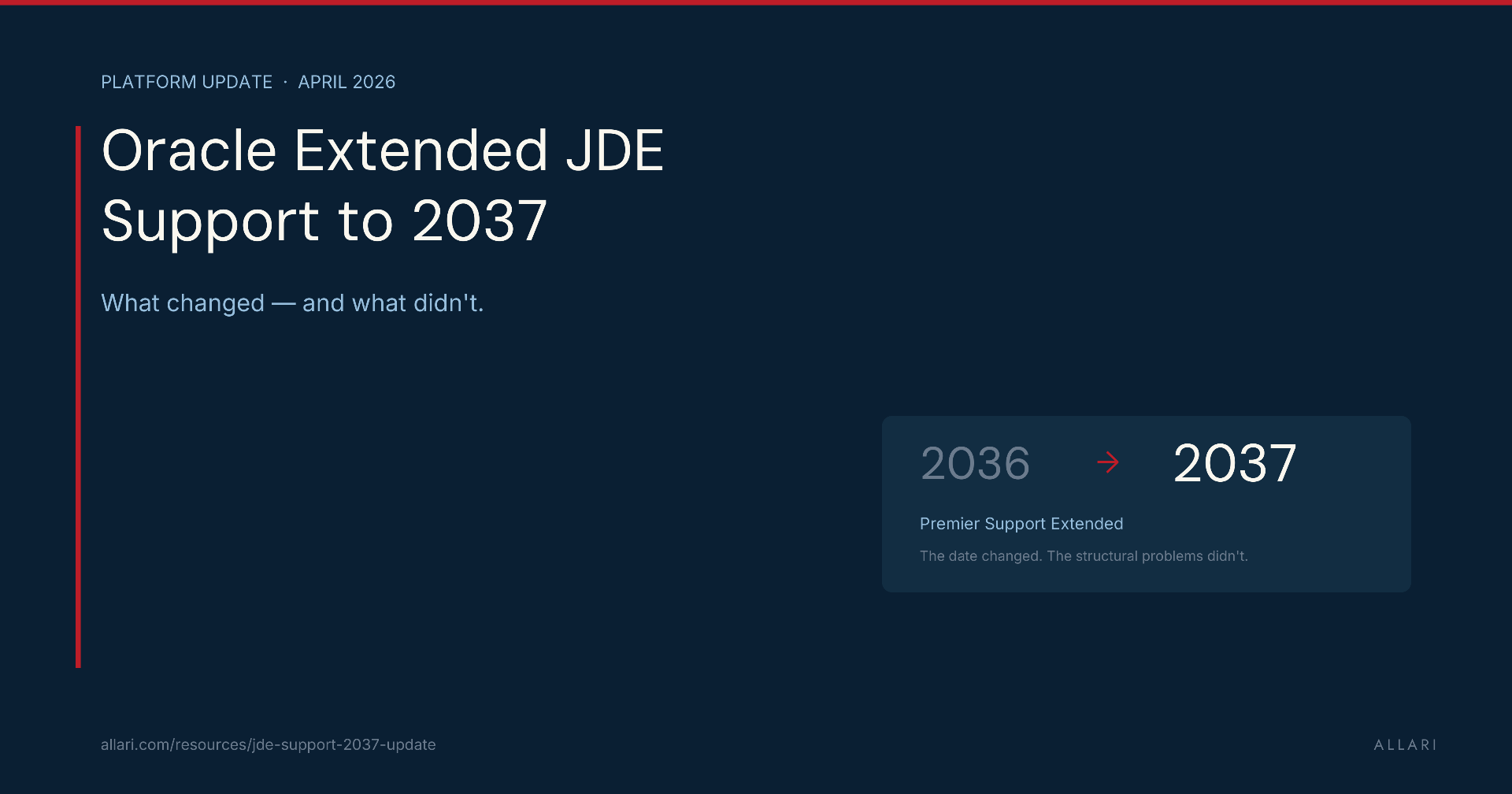
Oracle quietly updated its Lifetime Support Policy again. Premier Support for JDE EnterpriseOne 9.2 now extends through at least December 2037 — one year beyond the previous December 2036 commitment. This is the second extension in two years. If you've seen our own site reference 2036 in a few places, that number is now out of date. We're updating it.
2037
Premier Support End
2036
Previous Date
7,400+
JDE Install Base
1 yr
Extension Added
For JDE shops trying to make long-range planning decisions, the extension is worth understanding clearly — both what it actually changes and what it doesn't.
What Actually Changed
The support end date moved from December 2036 to at least December 2037. That's it.
The scope of Premier Support has not changed. You still get patches, tax and regulatory updates, new ESUs, and Tools Releases. Oracle did not announce new features. Oracle did not announce a changed product roadmap. Oracle did not announce new investment in JDE development. They moved a date by one year. Nothing else about the Premier Support commitment changed in substance.
JDE World is a separate story. A9.4 Extended Support ended in April 2025. World is now in Sustaining Support — the final, minimal-maintenance phase — and that status did not change with this announcement. The 2037 extension applies exclusively to EnterpriseOne 9.2.
What Didn't Change
A one-year support extension does not address the structural pressures that JDE environments are operating under. A few things that remain unchanged:
The talent market. The population of experienced JDE practitioners is not growing. The people who built their careers on EnterpriseOne are advancing in their careers, taking on broader roles, or moving toward retirement. Hiring a senior CNC admin or an experienced functional analyst in manufacturing is harder today than it was three years ago, and no support extension changes that pipeline.
"The question was never 'when does Oracle end support?' The question is 'when does our team's ability to operate JDE effectively fall below the threshold?'"
Oracle's own workforce reduction. Oracle is cutting 20,000 to 30,000 jobs to fund a $50 billion AI infrastructure buildout. Those cuts are concentrated in support, services, and partner-facing teams — which means the quality and responsiveness of Oracle's own JDE support organization is under real pressure regardless of what the policy calendar says.
The feature velocity gap. Release 26 shipped in October 2025 with meaningful enhancements in Orchestrator, Form Extensions, and the web-based Scheduler. That's the kind of capability JDE teams should be using. The problem is the same it's always been: teams that are consumed by reactive operations don't have bandwidth to evaluate and test new features, let alone deploy them. An extra year of Premier Support doesn't reclaim the 35-45% of core team capacity that reactive work consumes.
The competitive gap. Organizations that have moved to modern SaaS platforms are already integrating AI into their operational workflows in ways that JDE environments cannot match natively. That gap widens every year. A support extension to 2037 doesn't alter the AI integration trajectory of JDE versus Salesforce, Workday, or Oracle Fusion.
JDE World's situation. If you're on World, your system is frozen. That didn't change.
Why Oracle Keeps Extending
There are more than 7,400 organizations running JDE worldwide. That installed base represents a substantial recurring maintenance revenue stream. Every extension Oracle announces buys time — time for customers to stay put, time for Oracle to continue collecting maintenance fees, and time to prevent a competitive land grab by SAP, Workday, or Microsoft.
Extensions also lower the temperature in the market. When organizations believe a hard end date is approaching, conversations about competitive platforms accelerate. Oracle has a strong economic interest in dampening that urgency. Extending the date by a year is a low-cost way to do it.
None of that means the extension is bad for JDE customers. More runway is more runway. But understanding why Oracle makes these moves helps frame what the extension actually signals about Oracle's product investment, which is less than the announcement itself implies.
What It Means for Your Planning
If your organization had a migration or upgrade project targeting the 2035-2036 window, you now have a bit more flexibility in that timeline. That's the most direct operational implication.
If your organization didn't have a concrete plan in place, the extension changes nothing about the operational reality your team is living with today. Your core team is still managing a reactive incident load that consumes roughly 38.4% of their available capacity — the median we observe across the 62 Fortune 500 environments we work with. Your upgrade projects are still in the backlog. Your talent dependencies are still concentrated in a small number of people who carry institutional knowledge that isn't documented anywhere.
An extra year of Premier Support doesn't move those numbers.
The Real Timeline Question
The question JDE teams should be asking isn't "when does Oracle end support?" Support extension debates focus on a date that is, for most organizations, not actually the binding constraint.
The binding constraint is this: at what point does our team's capacity to operate JDE effectively fall below the threshold the business requires? For most organizations we talk with, the talent constraint arrives before the support end date does. The loss of one or two key practitioners — a CNC admin who takes a better offer, a functional lead who retires — can compromise operational stability years before any Oracle deadline.
The support calendar is Oracle's timeline. The capacity and talent picture is your timeline. Those are not the same timeline, and conflating them is one of the most common planning mistakes we see in JDE environments.
The 2037 extension gives your team more runway. How you use that runway — whether you use it to close the operational gaps that are already limiting your team today, or whether you treat it as permission to keep the status quo for another year — is the decision that actually matters.
Find out where your team stands.
See where your environment sits in the JDE lifecycle.
Take the Executive Diagnostic →