
JDE vs NetSuite for Mid-Market Manufacturing
An honest comparison.
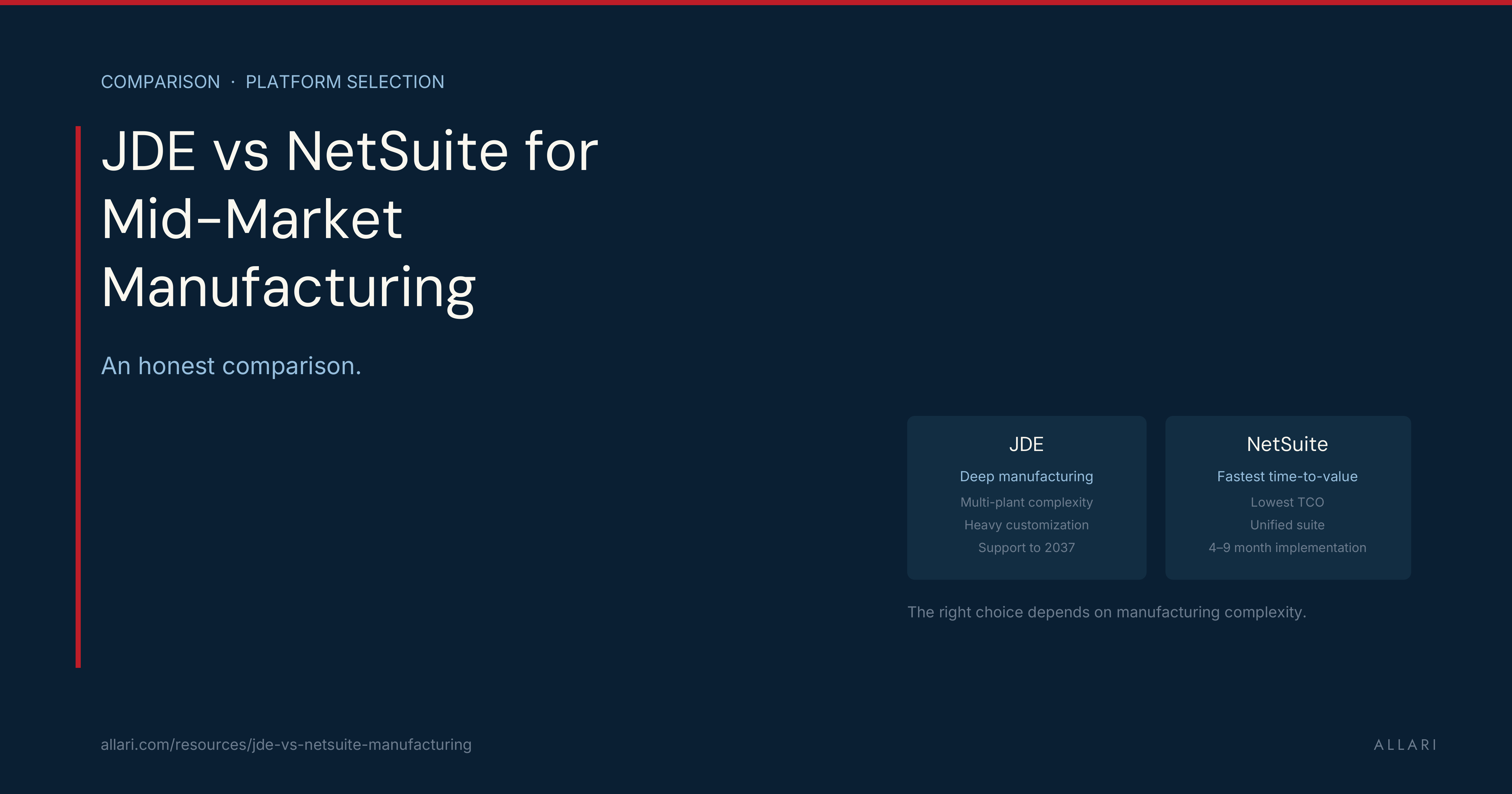
For mid-market manufacturers running JDE, NetSuite shows up on every shortlist. The pitch is compelling: cloud-native, unified suite, low TCO, and Oracle ownership. For some organizations, it's the right move. For others, it's a mismatch that becomes apparent six months into the implementation.
4-9 mo
NetSuite Timeline
2037
JDE Support
7,400+
JDE Install Base
$50M-500M
Target Revenue
Where NetSuite Wins
Time to value. NetSuite implementations typically run 4–9 months vs 12–24 months for Fusion or SAP.
Total cost profile. Subscription-based pricing with lower upfront costs and infrastructure overhead. For organizations in the $50M–$500M revenue range, the 3-year TCO comparison can be substantial.
Unified platform. Financials, CRM, e-commerce, and basic manufacturing in a single system. No integration layer to maintain.
Modern interface. Cloud-native UX requires less training. Embedded AI and analytics are native features rather than separate integrations.
Where Staying on JDE Wins
Manufacturing module depth. JDE's Shop Floor Management, Quality Management, Product Costing, and Advanced Planning represent decades of accumulated functional depth.
Customization at every layer. JDE allows modifications at the business function level, NERs, custom tables, and UBEs that support operations with requirements beyond configuration alone.
Existing investment. Decades of configuration, customization, integration, and institutional knowledge have real value that gets written to zero when you migrate.
Support runway. JDE EnterpriseOne 9.2 Premier Support runs through at least 2037. The 7,400+ organizations running JDE globally represent an active ecosystem.
| Dimension | JDE (Stay) | NetSuite (Migrate) |
|---|---|---|
| Time to Value | Already running | 4-9 months |
| Manufacturing Depth | Deep (Shop Floor, Quality, Advanced Planning) | Moderate (basic manufacturing) |
| Customization | Open modification, decades of investment | SuiteCloud, some ceilings |
| TCO | Sunk cost + operations | Lowest subscription model |
| AI | DIY through OCI | Embedded, analyst-friendly |
| Multi-Plant | Deep interplant, plant-specific config | Multi-subsidiary model, different approach |
| Regulatory | Decades of compliance depth (FDA, ISO) | Catching up |
Where NetSuite Falls Short for Manufacturing
Advanced scheduling. Organizations with complex constraint-based scheduling or finite capacity planning frequently hit limitations.
Multi-plant complexity. JDE was built for multi-facility, multi-country manufacturing. NetSuite's multi-subsidiary model approaches this differently and may create unanticipated complexity.
Regulatory depth. JDE's compliance features for FDA, ISO, OSHA, serialization, and batch control have been built and refined over decades in regulated environments.
Customization ceiling. For JDE environments with 150–200+ active customizations, roughly 30–40% may not have a clean SuiteCloud equivalent.
The platform decision is important. The capacity decision is upstream of it.
The Capacity Question Applies Either Way
Whether you migrate to NetSuite or stay on JDE, the operational capacity problem is the same. Core teams running at 38.4% reactive load cannot simultaneously evaluate platforms, participate in implementation workshops, manage data migration, and keep production running.
The Capacity Trap research documents this pattern. A platform decision made without an honest capacity assessment produces either a bad platform decision or a failed implementation.
How to Decide
How complex is your manufacturing? Advanced scheduling with finite capacity constraints or multi-plant operations → JDE likely fits better. Standard discrete manufacturing → NetSuite may be adequate.
How fast does the organization need to move? If speed-to-value is the priority and manufacturing is standard, NetSuite's 4–9 month timeline is a genuine advantage.
Does your team have the capacity to participate in a migration? This is the upstream question. If the answer is no, the platform choice doesn't matter yet.
Find out where your team stands.
Evaluate your platform decision with real capacity data.
Take the Executive Diagnostic →