
What Oracle SOAR Doesn't Solve
The automation gap between moving data and keeping operations running.
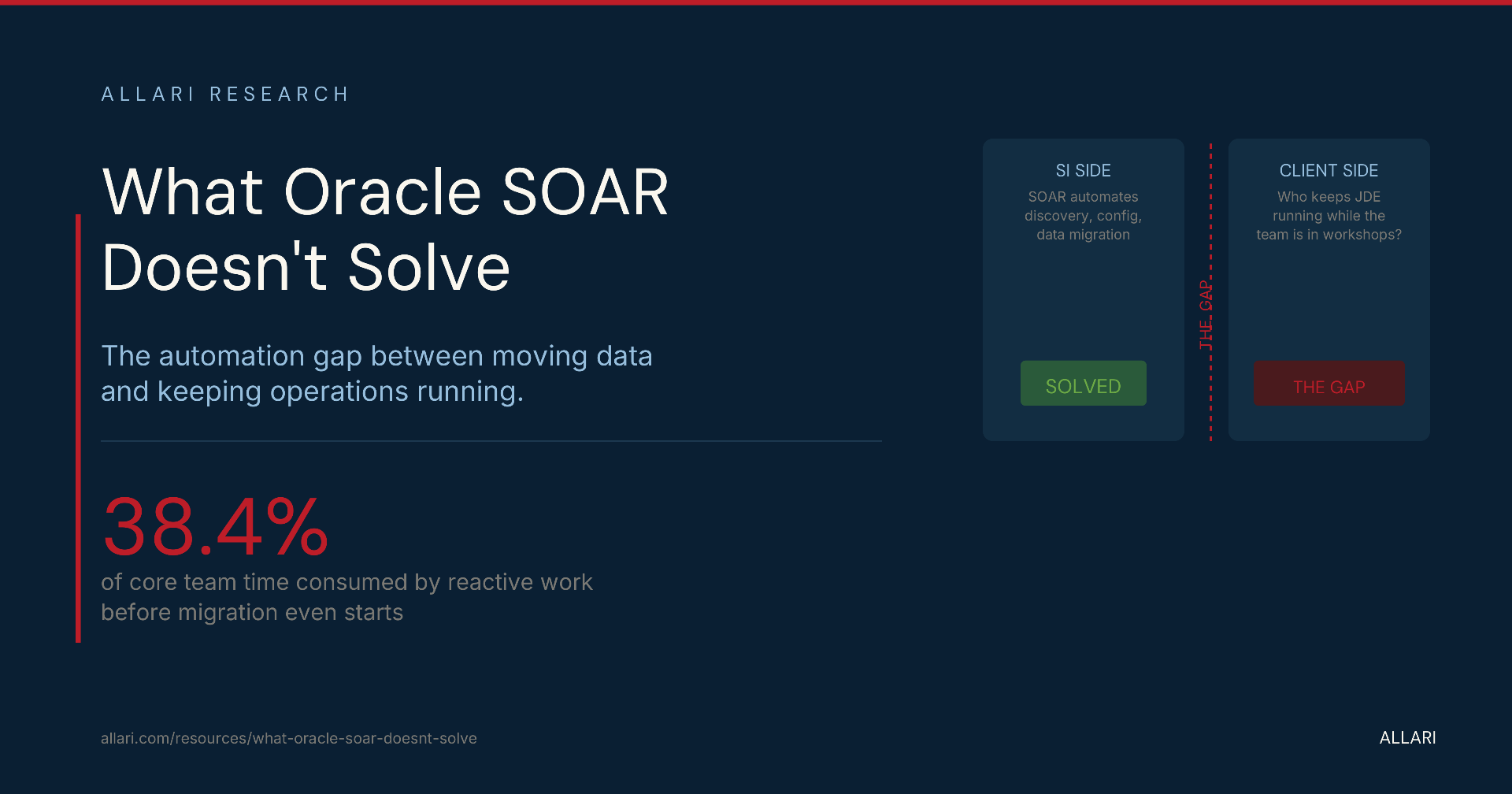
The Gap This Article Is About
Oracle SOAR is a real product that does real things. The 30% reduction in migration time and cost isn't marketing copy — it's built into the platform's design. The 20-week flight plan for E-Business Suite to Fusion ERP transitions reflects genuine compression of what used to take years. The automated discovery, configuration extraction, and data migration utilities address problems that previously required months of manual auditing. SOAR is a legitimate step forward in how enterprise migration gets done.
Our research report on Oracle SOAR documents all of this in detail. But the report's own Limitations section is where things get interesting — and where the real operational question starts to take shape.
The four limitations the report identifies are: reporting gaps post-go-live, customization debt that automation can scan but not automatically resolve, data integrity exposure if the cleaning phase isn't executed carefully, and scope creep when governance structures aren't in place. These are meaningful risks, and Oracle's response to each — closer alignment between consulting and product teams, structured governance through TCM+ — is substantive.
What the Limitations section doesn't mention is the people who have to keep JDE running while the migration is happening.
That silence is the gap this article is about.
The Assumption SOAR Bakes In
Oracle's True Cloud Method (TCM+) is the procedural backbone of every SOAR engagement. It works in distinct phases: Preparation and Strategy, Experience and Mapping, Definition and Configuration, Implementation and Integration, and finally Adoption and Evolve. Each phase is disciplined and well-documented.
The Experience and Mapping phase is the one that matters most for this conversation. It explicitly requires "hands-on workshops using client data" to map legacy features to cloud requirements. The objective is to drive user buy-in and confirm the business case. Without active client participation, the workshop doesn't produce what the SI needs to configure the system correctly.
Every week of the 20-week flight plan assumes the people who know JDE — the core team that runs it, supports it, and has lived with its customizations for years — can participate in design sessions, validate data mappings, test configurations, and answer the SI's questions with enough depth to keep the build moving.
Nobody asks: what are those same people doing when they're not in workshops?
Our forensic capacity data, collected across 62 Fortune 500 JDE environments, shows that 38.4% of the average core team's available time is consumed by reactive operations — tickets, incidents, workarounds, and unplanned interruptions. That isn't a bad week. That's the baseline. Before the migration project starts, before the first workshop is scheduled, before the SI mobilizes, the team is already operating at roughly 60% effective capacity.
SOAR's flight plan doesn't account for that 38.4%. Neither does any other migration automation tool. The Pre-Migration Health Check that should surface this number — the honest capacity baseline — rarely happens because the urgency to start the project eclipses the discipline to measure whether the team is ready for it.
The 90-Day Collapse Pattern
We've seen this enough times across JDE environments to recognize the pattern clearly. It isn't a staffing failure. It isn't a project management failure. It's a structural problem, and it plays out in three acts.
Days 1–30
The core team is running both workstreams simultaneously on adrenaline and goodwill. They're supporting production, managing the ticket queue, and showing up for the SI's workshops. It feels sustainable because it's new, and new things carry momentum. The metrics look fine. The project status report is green.
Days 31–60
The reactive load starts winning. Tickets that used to get resolved in hours are aging to days. Workarounds start replacing root-cause fixes because root-cause fixes require time the team no longer has. The SI's questions take longer to get answered. Some questions don't get answered at all — the person who knows the answer is in the middle of a production incident. Sprint velocity slows. The timeline starts to flex.
Days 61–90
Something breaks. Not necessarily a catastrophic failure — though sometimes it is — but a threshold gets crossed. Production incidents spike because the workarounds from weeks three through eight have accumulated into new failure modes. The SI's timeline extends because the configuration decisions that were deferred in weeks four through six now require rework. The core team's best people — the ones the SI depends on the most — start updating their resumes because they've been operating above capacity for two months and they can see what the next six months look like.
This is The Capacity Trap: the people running JDE are the same people the SI needs for the build. They cannot be in two places at once. SOAR's automation compresses the SI's workload significantly. It does nothing for the client team's operational load. No automation tool does.
Understanding the full scope of why this pattern produces implementation failure — not just capacity constraints but governance gaps, scope management, and SI oversight issues — is documented in our JDE Lifecycle Hub.
What the Other Half Looks Like
The structural answer is bifurcation. One team owns production. A different team owns the future. Neither team interrupts the other.
We call this the Operational Airlock: a deliberate separation of operational custody from build participation, designed so that production incidents cannot propagate into the migration project and migration demands cannot drain the operations team.
In practice, this means Allari takes full custody of JDE operations during the migration period. We own the ticket queue, the incident response, the monitoring, the root-cause work. The client's core team can participate in the SI's workshops, validate configurations, and make the decisions that only they can make — without their phone buzzing with a production alert halfway through a data mapping session. This is what Stage 3: JDE Operations During Migration looks like inside our lifecycle model.
The capacity measurement that makes this work is the Power of 15 — our forensic method for making the invisible work visible. Most JDE operations have no honest accounting of where time actually goes. The 38.4% reactive load figure isn't intuitive to most leadership teams because nobody tracks it at that level of granularity. The Power of 15 produces the baseline that tells you, before migration starts, exactly how much bandwidth the core team has and how much it will take to free them for the build.
The deflationary cost model matters here too. As we eliminate root causes — the recurring incidents, the systemic workarounds, the tickets that should never have been tickets — operations get less expensive over time. The cost trajectory runs opposite to what scope-expanding migration projects typically produce.
The results from our field work support this. HellermannTyton achieved an 89% reduction in ticket aging and a 5.4-week payback period on the operations model. More directly relevant to migration dynamics: W.L. Gore ran 26,518 service interactions over 24 months with zero escalations reaching the build team, and 25 FTEs were freed to participate in the SAP implementation. The flight plan timeline held because the operational airlock held.
Stage 4: Client-Side SI Oversight documents the governance layer that sits alongside this — making sure the build team has what it needs from the client without that demand routing back through an already-taxed operations team.
Where SOAR and Allari Intersect
SOAR and Allari are not competitive offerings. They operate in different parts of the migration equation.
SOAR handles the technical migration mechanics — automated discovery, configuration extraction, data migration, environment provisioning, and the TCM+ procedural framework that keeps the SI accountable. These are real capabilities that genuinely reduce the SI's burden and compress the timeline.
Allari handles the operational capacity that makes the timeline achievable on the client side. Without that capacity, the 20-week flight plan becomes a 40-week flight plan — not because the automation failed, but because the people the automation depends on ran out of bandwidth at week six.
The gap between them is where most implementations fail. According to the research we've compiled in Why ERP Migrations Fail, 75% of ERP implementation projects are classified as failures, and only 8% of S/4HANA migrations complete on schedule. The automation tools keep improving. The client-side capacity problem hasn't changed.
The Core Insight
SOAR closes the SI-side gap. The Operational Airlock closes the client-side gap. Both are necessary. Neither substitutes for the other.
The Question Worth Asking First
The question isn't whether to use SOAR or similar migration automation tools. For organizations moving from JDE or other Oracle Applications Unlimited platforms to Fusion Cloud, the automation is worth using — the economics are real and the timeline compression is real.
The question is whether the core team has the bandwidth to participate in the process those tools require. If 38.4% of their time is already consumed by reactive operations before the migration starts, the flight plan doesn't need better automation. It needs an operational airlock.
A Pre-Migration Health Check that measures actual capacity — not headcount, not FTE allocations, but where time actually goes — is the starting point. Without that number, any migration timeline is an assumption, not a plan.
Find out where your team actually stands.
The Executive Diagnostic measures your team's actual available capacity — so you know whether your migration plan is realistic before you commit.
Take the Executive DiagnosticA 45-minute structured review of your environment's capacity allocation. Not a sales conversation. We bring the benchmark data. You bring the questions.