
What Happens to Your JDE Support After 30,000 Cuts
The operational impact JDE managers are feeling right now.
Related: Read the strategic analysis — Oracle Is Cutting 30,000 Jobs →
Our article on Oracle's 2026 workforce reductions has been the most-read page on our site for months. The strategic picture — Oracle cutting 20,000 to 30,000 jobs to fund a $50 billion AI infrastructure investment — is well-documented and widely covered.
30,000
Jobs Cut
$50B
AI Buildout Budget
$2.1B
Restructuring Provision
6-12 mo
Hiring Window
What JDE application managers keep asking us about is more immediate. "My SR response times are getting worse." "The support representative who used to know our configuration is gone." "Patch quality feels different." These are not strategic observations. They are operational signals from people managing live environments right now.
What JDE Managers Are Reporting
Across our client conversations and the broader JDE community, a consistent pattern has emerged over the past two quarters.
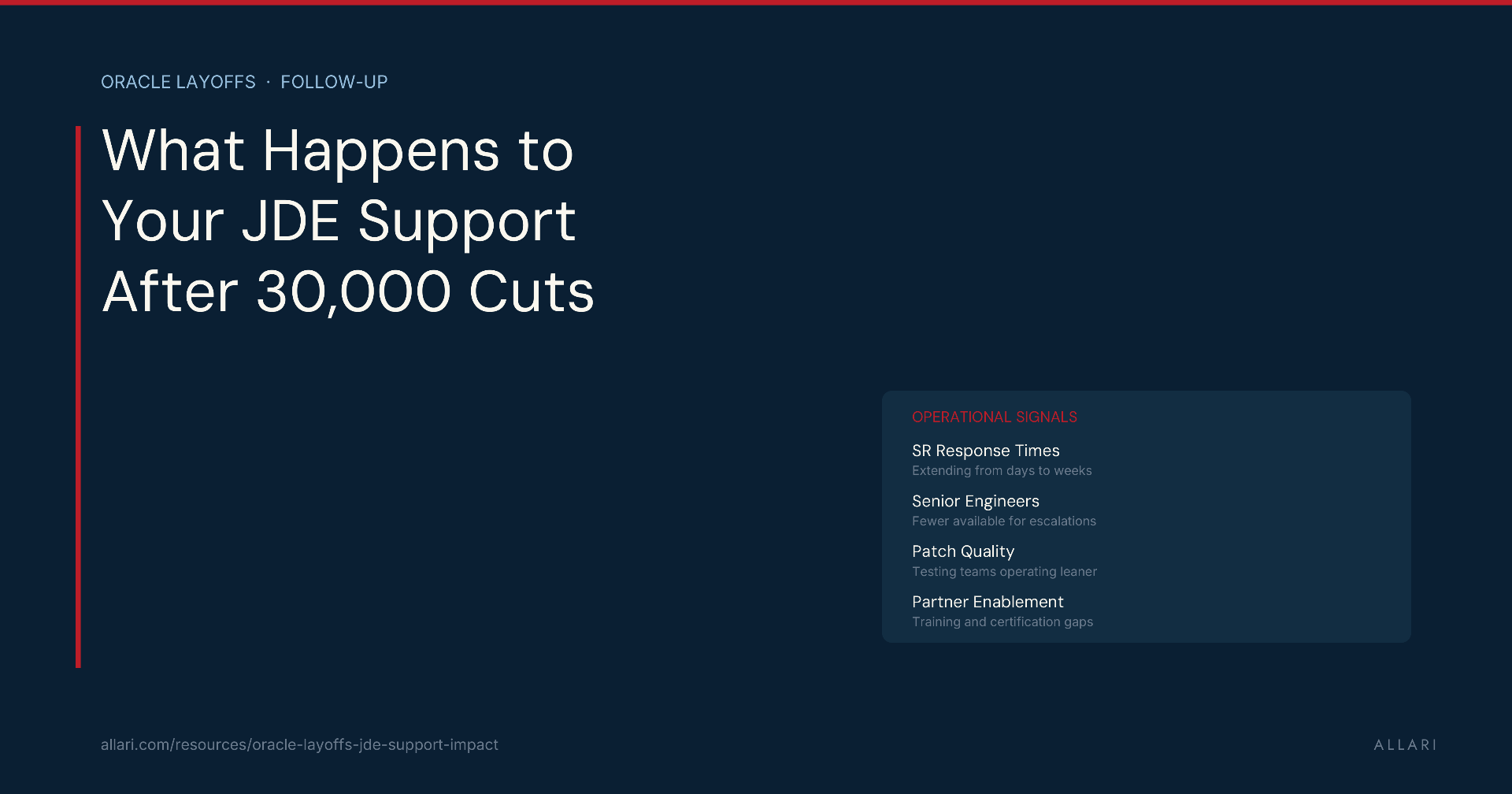
Service Request response times for non-critical issues are extending. What used to take three to five business days is now taking longer. Responses that arrive quickly are more often generic guidance — documentation links, standard diagnostic questions — rather than environment-specific analysis. The number of senior Oracle support staff available for complex escalations has thinned. People who knew specific customer configurations and could recognize symptoms quickly are being replaced, if at all, by staff earlier in their JDE learning curve.
"The people being cut are not being replaced by AI. They are being replaced by concrete, copper, and GPUs."
Knowledge continuity is a specific concern. JDE is a deep, configuration-intensive platform. An Oracle support representative who has worked your type of environment for several years builds a knowledge base that is genuinely valuable. When that person leaves, the next SR interaction starts from zero on context. Customers who relied on specific support contacts report that the organizational knowledge those people carried is not being documented or transferred — it simply departs.
Patch release quality is harder to assess from the outside, but the concern appears in multiple conversations. Smaller testing teams mean less test coverage per release cycle.
The Severity Tiers Most Affected
Oracle's SLA commitments are tiered by severity. Severity 1 and 2 incidents — system down, critical function unavailable — are likely to maintain contractual response time targets. Oracle cannot afford contractual breaches at scale, and the legal and reputational exposure from missed critical-issue SLAs is too high.
| Severity | Impact | Risk Level |
|---|---|---|
| Sev 1-2 | SLAs likely maintained | Low |
| Sev 3-4 | Response times extending, knowledge gaps | High |
| Partner Enablement | Training/certification gaps | Medium |
The erosion is happening in Severity 3 and 4. These are the tiers that cover configuration questions, feature guidance, how-to inquiries, best practices for Tools Release adoption, and the kind of technical investigation that sits below "production is down" but still consumes real time when it's unresolved. Severity 3 and 4 interactions depend on institutional knowledge. They require support staff who understand JDE architecture well enough to interpret a customer's specific situation rather than route them to documentation.
Those interactions are becoming noticeably less reliable. For most JDE shops, Severity 3 and 4 SRs are the plurality of their Oracle support activity. The degradation there is operationally significant even if it rarely makes headlines.
The Partner Enablement Gap
This is the second-order effect that most organizations haven't factored into their planning.
Oracle's partner ecosystem — GSI, Circular Edge, Syntax, Allari, and others — depends on Oracle for more than just reseller relationships. It depends on Oracle for training materials, certification program updates, early access to patches for testing, technical guidance on complex platform questions, and the ability to escalate issues that go beyond what a partner can resolve independently.
When Oracle's partner-facing teams shrink, those channels degrade. Training materials update more slowly. Certification programs reflect a version of the product that's one cycle behind. Early patch access becomes less consistent. Partner escalation paths to Oracle's senior technical staff become harder to navigate.
The downstream effect reaches every organization served by the partner ecosystem. If the consultants and co-managed operations partners who support your JDE environment are getting slower, less current, or less well-supported by Oracle, the operational impact reaches your team whether or not you ever contact Oracle directly.
What to Do About It
Three practical steps worth taking now, regardless of your Oracle contract status.
Map your Oracle touchpoints. Document every category of interaction your team or your partners have with Oracle: SR filings, patch downloads, certification renewals, partner support escalations, training and enablement resources. Most organizations have a fuzzy sense of this. Making it explicit tells you where your exposure is concentrated.
Separate what requires Oracle from what doesn't. Some things genuinely require Oracle — security patches for unresolved CVEs, tax and regulatory updates, new ESUs, Tools Release binaries. Those are legitimately Oracle-dependent. Many other things — CNC administration, incident triage, performance diagnosis, root-cause analysis, CNC package builds, functional configuration guidance — do not require Oracle. They require experienced JDE practitioners. Knowing the difference tells you where you can build operational self-sufficiency and where you remain exposed.
Build toward self-sufficiency on the non-Oracle-dependent work. The less your team's operational stability depends on Oracle's shrinking support organization, the less the layoffs affect your daily operations. This isn't about cutting off Oracle — you still need them for patches and regulatory updates. It's about not relying on Oracle for the operational knowledge your own team and partners should own.
The Hiring Window
One practical positive signal in all of this: Oracle's layoffs are releasing experienced JDE professionals into the market. CNC admins, functional analysts, project managers with JDE implementation experience — people with this background have been difficult to recruit for years. The near-term supply is temporarily elevated.
If you've been trying to fill an open JDE role and losing candidates to competing offers or salary expectations you couldn't meet, the next six to twelve months represent a window. It won't stay open indefinitely. Many of the people leaving Oracle will find positions quickly, and the long-term trajectory of the JDE talent market continues to contract as the practitioner population ages and fewer people train into the platform.
This is also why "the layoffs put people on the market short-term" is the accurate framing — not that the talent situation is structurally improving. A temporary increase in available candidates is a hiring window, not a talent market recovery.
The Operational Implication
Oracle's support organization is your backstop, not your primary support layer. It always should have been. The organizations most exposed to Oracle's workforce reductions are the ones who treated Oracle SRs as the first line of response rather than the last.
If your team routes routine operational questions through Oracle SR rather than through internal expertise or a co-managed operations partner, you're reliant on a support tier that is currently under structural pressure. That reliance is worth examining now, before a critical incident reveals how much you were depending on Oracle's responsiveness.
Find out where your team stands.
Assess your operational exposure.
Take the Executive Diagnostic →