
Is JDE Still a Viable Career in 2026?
The answer for practitioners and hiring managers are different.
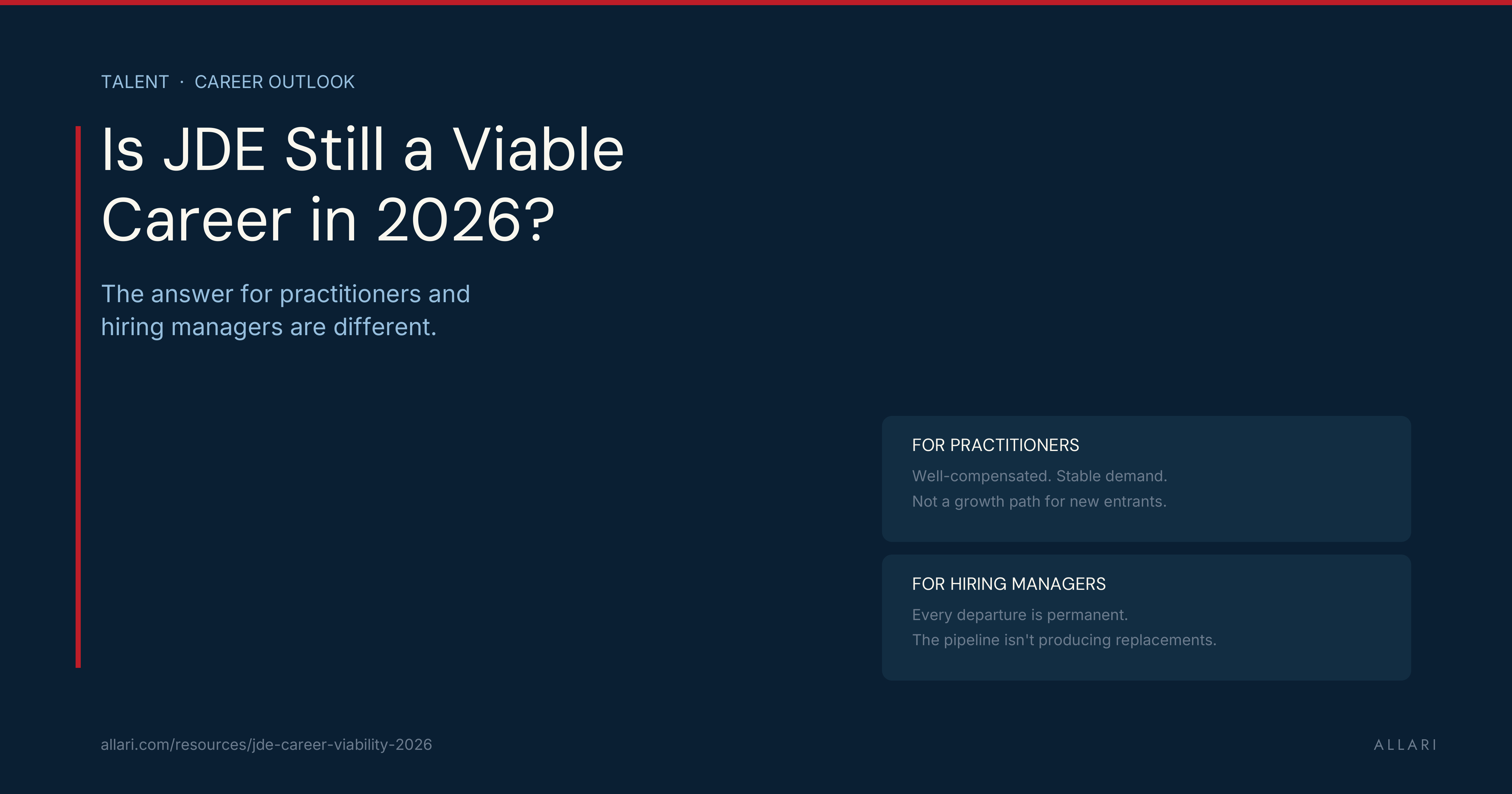
We see this question in every JDE community forum, every LinkedIn thread, every conference hallway conversation. People early in their ERP careers asking whether JDE is a dead end. People mid-career wondering whether to retool for Fusion or S/4HANA. And on the other side of the table: IT leaders wondering whether they'll be able to hire the JDE specialists they need in 2028, 2030, 2032.
7,400+
Organizations on JDE
2037
Support Runway
$135K
Senior CNC Ceiling
138
Open Positions
The Honest Answer
JDE is not dying. More than 7,400 organizations run it. Oracle extended Premier Support through at least 2037. Release 26 delivered meaningful enhancements. Orchestrator is genuinely powerful automation tooling with real value in complex operational environments.
But "not dying" and "a growth career path" are different things. JDE is a viable and well-compensated career for experienced practitioners. It is not a natural growth path for new entrants. The difference between those two statements is the entire talent story.
Why It Pays Well
Supply and demand. Senior CNC administrators command $86K–$135K annually, with top markets pushing past $230K. Experienced JDE functional analysts with deep module knowledge — finance, manufacturing, distribution — are in consistent demand and priced accordingly.
For someone already holding deep JDE expertise, this is not a bad place to be. The market will pay for the skills. Given Oracle's 2037 support commitment and the replacement cycle reality for large ERP environments, the runway is generally stable.
Why New Talent Isn't Entering
Oracle's investment signals point to Fusion and cloud. University programs don't include JDE in their curricula. The 2026 workforce reductions — Oracle cutting 20,000–30,000 jobs — sent a market signal that legacy platforms are being deprioritized at the vendor level.
The certification pathways for JDE are aging. The community is smaller. The networking and professional development ecosystem is thin compared to what surrounds Salesforce, SAP S/4HANA, or Oracle Fusion. The result: the JDE practitioner community is aging with limited inflow.
"JDE will be running in production environments for at least another decade. The structural challenge is that the community serving those environments is contracting."
What This Means for Hiring Managers
Every JDE specialist who retires or migrates to cloud represents a permanent reduction in available talent. That reduction is not replaced. There are 138 JDE CNC Administrator job listings on LinkedIn right now.
Capture knowledge before it leaves. The Dynamic Runbook is built specifically for this — creating living operational records that capture the environment-specific knowledge that isn't in any Oracle documentation.
Reduce dependency on specialized headcount. When 38.4% of core team time is consumed by reactive work (our median across 62 environments), the operational model is creating dependency rather than reducing it.
Plan for continuity, not replacement. The assumption that you can fill any JDE role within a reasonable timeline is becoming less reliable every year.
For Practitioners Considering the Switch
If you're thinking about moving from JDE to Fusion or S/4HANA, you carry something cloud-native consultants don't have: deep understanding of legacy ERP operational complexity. That understanding is valuable in migration projects, post-go-live stabilization, and hybrid environments.
JDE will be running in production environments for at least another decade. The work is real, the compensation is strong, and the demand is genuine. The structural challenge is that the community serving those environments is contracting.
Find out where your team stands.
Assess your JDE talent and capacity position.
Take the Executive Diagnostic →