
The JDE CNC Administrator Is a Disappearing Role
138 listings. A contracting talent pool. And the role your entire environment depends on.
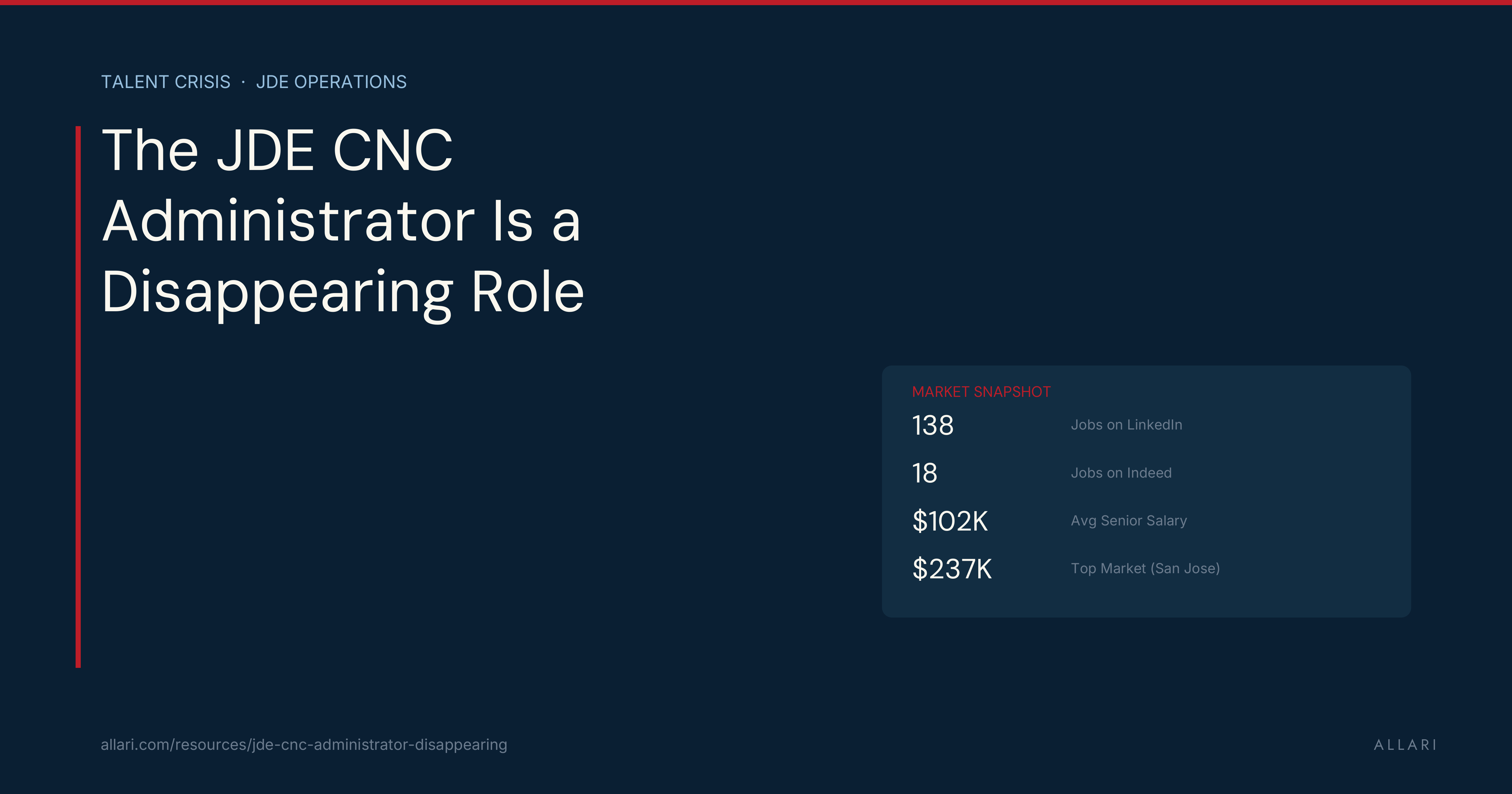
The JDE CNC administrator is one of the most critical roles in any JD Edwards environment — and one of the hardest to fill. CNC manages the technology stack that everything else runs on: package builds, ESU deployments, environment management, server administration, deployment tooling. When this role is vacant or understaffed, everything downstream slows. Releases get delayed. Patches sit in a queue. The people who depend on the system wait.
138
LinkedIn Job Listings
18
Indeed Listings
$102K
Avg Senior Salary
$237K
Top Market
That pressure is not going to ease. The market for JDE CNC talent has been tightening for years, and the trend line only moves in one direction.
The Market Reality
There are 138 JDE CNC Administrator job listings on LinkedIn right now. That's not 138 candidates — that's 138 open positions competing for a shrinking pool of people who know how to do this work. Indeed shows 18 postings. The numbers tell the story: this is a specialty that produces fewer practitioners every year.
The compensation reflects the imbalance. General JDE CNC roles run $41K–$69K annually ($20–$33/hr), with an average around $49K. Senior JDE CNC administrators command $86K–$135K ($41–$65/hr), with top markets like San Jose pushing past $230K. Comparably reports the average E1 CNC administrator is earning around $120K.
Demand is up. Supply is down. The economics are moving in one direction.
Why the Pipeline Dried Up
Nobody entering the workforce in 2026 is choosing "JDE CNC Administrator" as a career path. Oracle's investment signals point to Fusion and cloud. University programs don't teach JDE. The certification pathways are stale. Oracle's 2026 workforce reductions — 20,000–30,000 jobs — sent another signal to the market: legacy platforms are not where the future is being built.
The people who know CNC are the ones who learned it 10–20 years ago. They're retiring, being recruited into cloud roles, or burning out from being the only person who knows how to run a package build at 2AM. There is no meaningful inflow of new practitioners. The community is aging and contracting.
This is not a temporary gap. It's a structural shift. The JDE CNC practitioner pool is not going to replenish itself.
The Key-Person Risk
In most JDE environments, CNC knowledge is concentrated in one or two people. When one of them leaves, the organization doesn't lose a resource — it loses the ability to deploy code, manage environments, and apply patches on its own.
"We've seen environments where a single CNC admin departure created a 6-month recovery period."
Not because the work is impossibly complex, but because the knowledge of how this specific environment is configured was locked in one person's head. The business logic for why certain parameters are set the way they are. The sequence of steps that has to happen before a package build on this particular server configuration. The reason a specific environment flag is set to a non-default value — and what happens if someone resets it.
None of that is in any Oracle documentation. It's tribal knowledge. And when the person carrying it leaves, it's gone.
"You can't hire your way out of a market with 138 listings competing for a declining talent pool."
The Structural Fix
Two things need to happen.
The first is capturing institutional knowledge before it walks out the door. This is exactly what the Dynamic Runbook is built for — documenting the environment-specific configurations, procedures, and tribal knowledge that exist only in people's heads.
The second is building operational depth that isn't dependent on whether you can fill a position in a market with 138 listings. A co-managed operations partner that provides CNC coverage through specialists who have worked across dozens of JDE environments brings both depth and continuity.
You can't hire your way out of a market where 138 open positions are competing for a declining talent pool. The organizations that navigate this well are the ones that stop treating it as a hiring problem and start treating it as a structural operational problem.
What to Do This Quarter
Start with an honest audit of your CNC key-person dependencies. Identify every procedure that only one person knows. Every environment configuration that only one person understands. Every deployment sequence that hasn't been written down because "everyone just knows how to do it."
Then start documenting. Even rough documentation is better than none, and rough documentation can be refined over time into something that actually survives personnel changes.
The capacity trap research we've done across 62 Fortune 500 environments shows that reactive work consumes 38.4% of core team time at the median. That number goes up sharply when a key-person departure forces everyone else to absorb work they weren't carrying before.
Find out where your team stands.
Assess your CNC staffing exposure.
Take the Executive Diagnostic →