
The Cost of Running JDE Without Documentation
When tribal knowledge walks out the door.
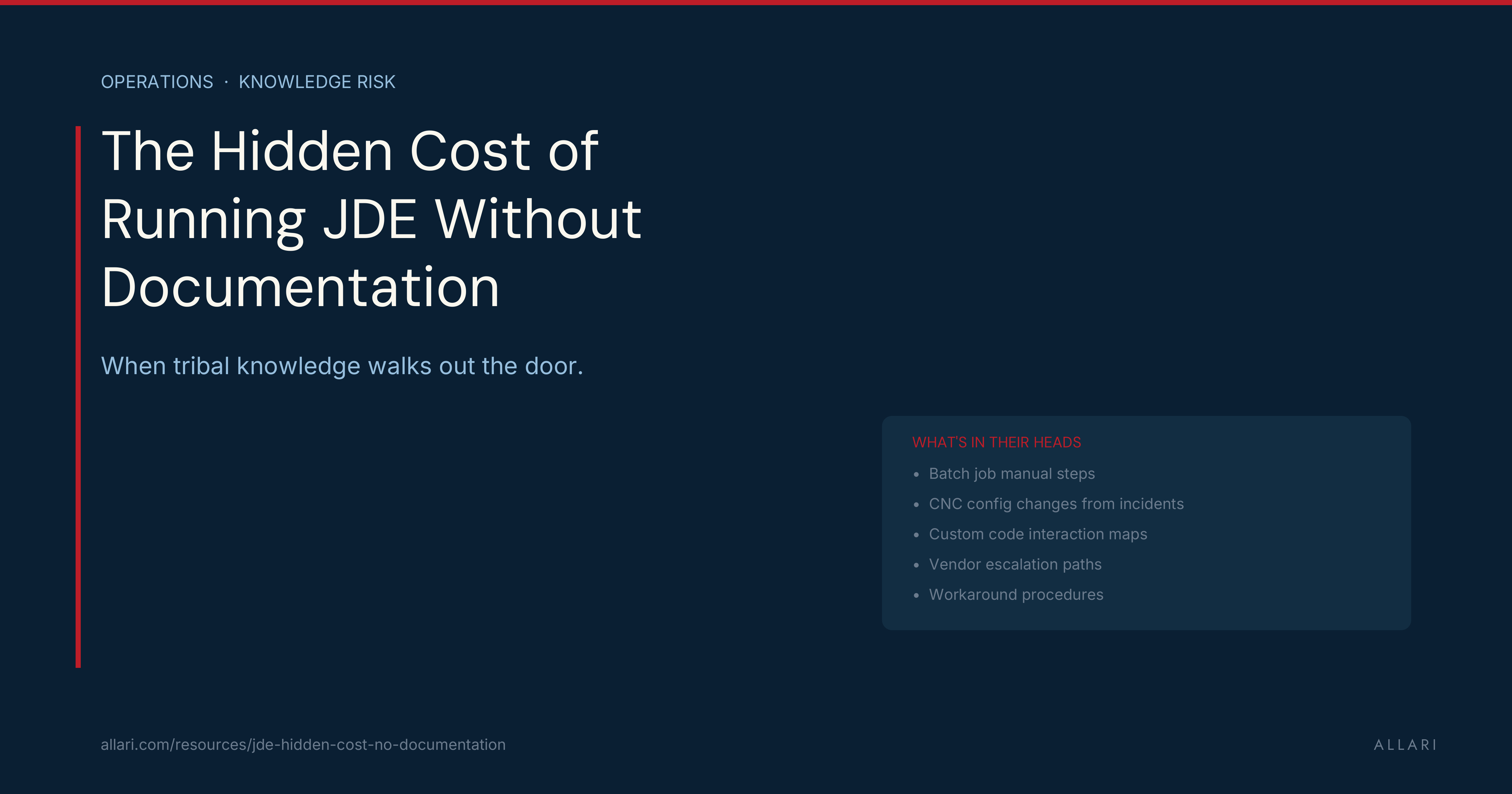
Ask any JDE application manager whether their environment is fully documented. The answer is almost always the same. There is some documentation — a network diagram from three years ago, some notes in a SharePoint folder from the last upgrade project. And then there is the real documentation: what lives in two or three people's heads.
2-3
People Who Know
3-6 mo
Recovery After Departure
100%
Of Knowledge at Risk
0
Pages Documented
What Undocumented Knowledge Actually Costs
A single departure of a long-tenured JDE resource can trigger a 3-to-6-month stabilization period. Incidents that took 30 minutes to resolve now take 4 hours. Batch jobs fail because the manual step nobody documented was not performed. ESU testing takes twice as long because nobody recorded which customizations interact with which standard objects.
Each of those outcomes has a real cost. And each of them was entirely preventable.
The Compounding Risk
Every month without documentation, new configurations get added. Workarounds get layered on top of older workarounds. The people carrying that knowledge become more critical — and more burned out, because they are the only ones who can handle certain incident types.
This is key-person dependency, and it is the most common form of operational risk in JDE environments.
Documentation is important but never urgent. Production incidents are urgent. Business requests are urgent. Documentation gets added to the backlog and stays there.
Why Documentation Never Gets Done
The reason is structural, not motivational. Documentation is important but never urgent. A production incident at 2 AM is urgent. An ESU cycle that needs to start next Monday is urgent. Documentation gets pushed to next quarter every quarter.
Institutional knowledge transfer only happens under crisis conditions: when someone is transitioning out and there are two weeks to extract 11 years of context.
The institutional knowledge stays in their heads because they never have time to write it down.
What a Dynamic Runbook Changes
A Dynamic Runbook is not a static document. It is a living operational record that tracks the environment as it evolves: when a configuration changes, why it changed, what problem it was solving. Any qualified specialist can follow it to operate the environment at full competency.
When a resource transitions, the runbook ensures continuity. When an incident occurs at 2 AM, the person handling it has documented procedures rather than improvising from incomplete memory.
Where to Start This Quarter
Start with the ten things only one person knows. The critical batch job with the undocumented manual step. The vendor escalation path that actually works. The CNC configuration that requires a specific sequence to change safely. Document those first.
Then ask whether the people who carry this knowledge have the bandwidth to transfer it. Protecting time for knowledge transfer requires reducing the reactive load so the strategic work can actually happen.
Find out where your team stands.
Assess your documentation and key-person risk.
Take the Executive Diagnostic →