
When Your JDE MSP Loses Key People
What actually happens to your environment.
Circular Edge recently highlighted something every JDE application manager has experienced: when the person who knows your environment at your support provider leaves, you start over. New person, new learning curve, new mistakes. The continuity breaks. And depending on the complexity of your JDE configuration, that ramp-up period can stretch into months.
What Turnover Actually Costs
"Tickets that the previous person would have resolved in 30 minutes now take 4 hours because the new person is learning your environment."
ESU deployments that used to be routine become higher-risk events. Batch job failures that the previous person would have diagnosed in minutes take longer because the dependency sequencing was never documented — it was just known.
The knowledge of which customizations interact, which batch jobs are sequenced dependencies, which environment configurations are non-standard — all of that transfers poorly in a provider handoff. What transfers is job history and general JDE experience. What doesn't transfer is the operational memory of your specific environment.
Why It Keeps Happening
Traditional support models pay JDE specialists to sit on one or two accounts. When those specialists get a better offer — and in this talent market, they will — the provider scrambles to backfill. The replacement has JDE experience, but not your JDE experience.
"The question is where the knowledge lives. If it lives in people's heads, turnover will always be disruptive."
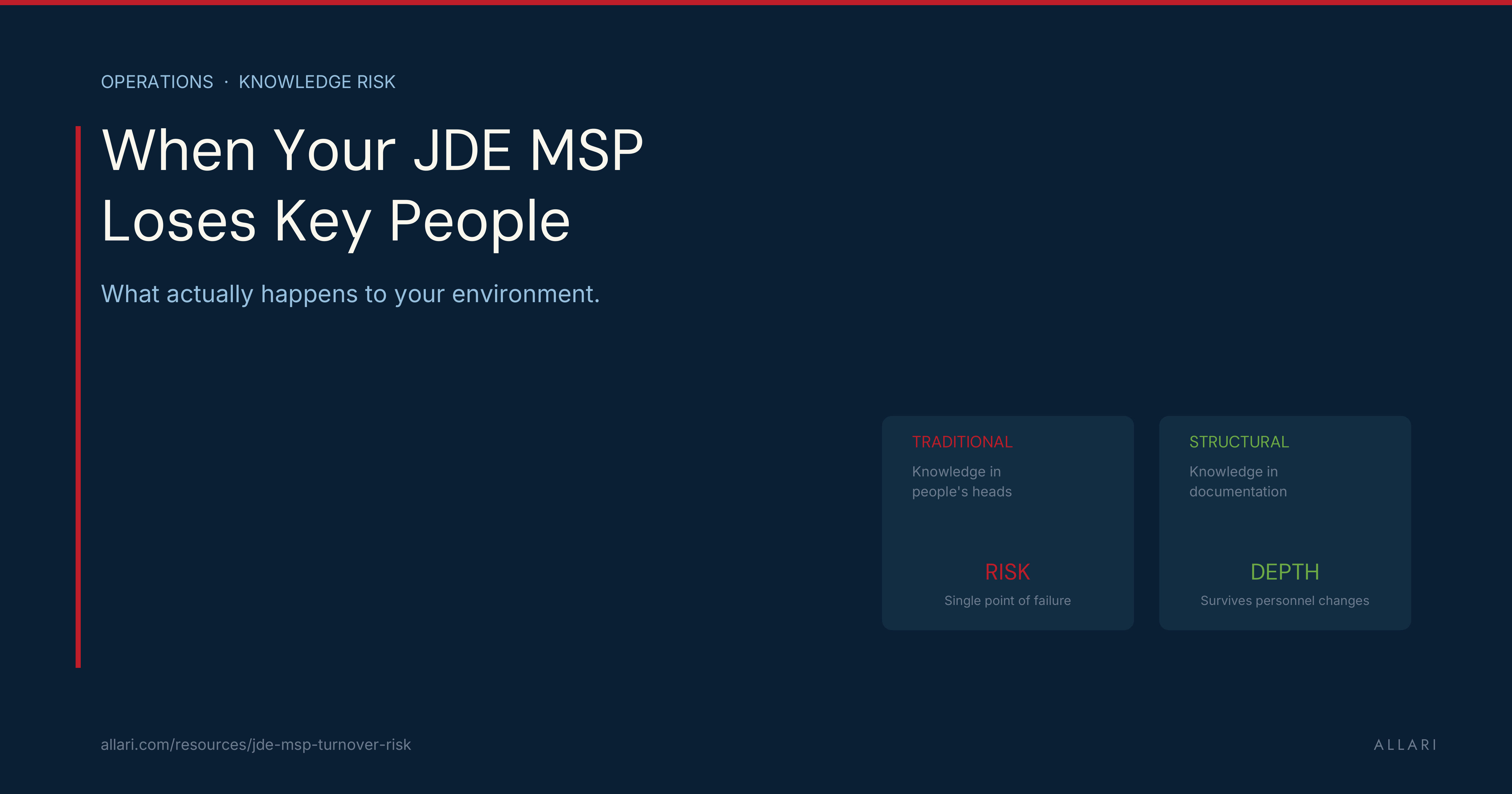
This is the structural problem. When the knowledge of how an environment works lives in a person's head rather than in documented, maintained operational records, every personnel change is a knowledge loss event.
There are 138 JDE CNC Administrator listings on LinkedIn right now — 138 open positions competing for a shrinking pool of practitioners. When a provider loses a specialist, they're fishing from the same depleted pond everyone else is.
The Structural Alternative
The alternative is a model where knowledge belongs to the engagement, not to the individual. The Dynamic Runbook captures environment-specific configurations, procedures, and operational context in a living document that any qualified specialist can follow. When personnel rotate, the runbook remains. The institutional knowledge doesn't leave with the person.
Combined with a team-based model where multiple specialists maintain familiarity with each environment — rather than one person owning one account — turnover becomes a staffing event, not a knowledge loss event.
| Question to Ask Your Provider | What a Good Answer Looks Like |
|---|---|
| Where does environment knowledge live? | Documented runbook, not one person's head |
| What's the continuity plan if our contact leaves? | Multiple specialists familiar with your environment |
| Could a new specialist operate our environment within a week? | Yes, using the documented runbook |
Find out where your team stands.
Assess your operational continuity risk.
Take the Executive Diagnostic →